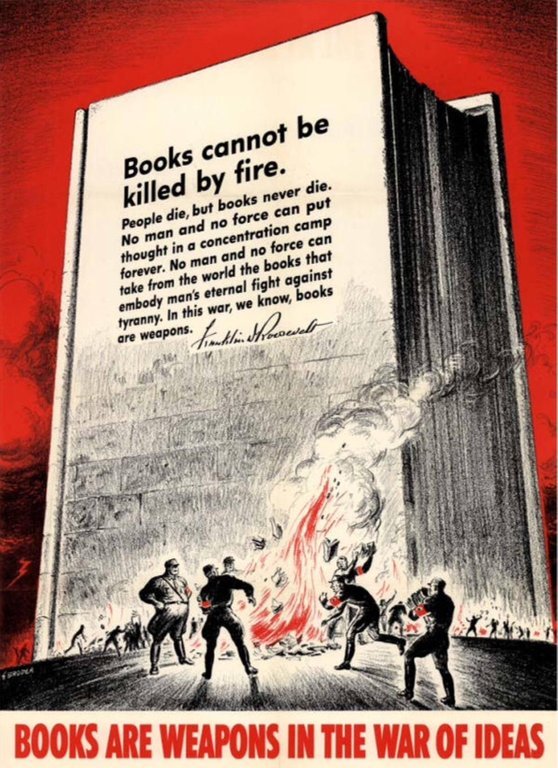
Something to keep in mind when extremists of any camp insist that this or that book should never be read because the author was a (insert ideologically based insult here)...
Censorship is a sign of weakness and fear, and this is true of both the Nazi book burners of the 1930's and the liberoid book banners of today. Those who are confident and sincere in their beliefs aren't afraid of debate in the marketplace of ideas.
Would I be correct in assuming that a lot of that is going on in the US these days? A sad state of affairs, if so. I have not noticed it in Canada; however, the media here are even more rabidly anti-"alternative medicine" than usual these days due to fears of measles making a comeback (via the US).
There aren't many bonfires, at least yet, but it's become highly fashionable among the politically correct to insist that nobody ought to be allowed to read any book written by any person who ever, at any moment in their lives, said or did anything at which today's guardians of politically correct moral decency can find a way to take offense. (And they work very hard at finding ways to take offense; it's quite the competitive sport these days.)
One recent example? Laura Ingalls Wilder's vivid and charming chronicles of her frontier childhood, from Little House in the Big Woods on. Those have been put on the list of banned books because Wilder once -- just once -- used the word "people" to mean "white people," without taking Native Americans into account. That one clumsy moment was enough to get her labeled an evil racist whose books should never be read by anyone ever again. It's exactly the same logic used by those guys with the armbands, in their crusade against "degenerate" art and literature.
Wow - that is breathtaking! The closest thing I can think of up North is the controversy surrounding the continuance of "To Kill a Mockingbird" in the Grade 10 English curriculum(it has been a cornerstone of Grade 10 English for at least 40 years, because I studied it when I was in high school). Of course it is "controversial" due to race issues/language (white/black/indigenous). Why not throw the baby out with the bathwater? Who cares if it is a brilliant piece of literature? (Beats the pants off that other high school English cornerstone "Wuthering Heights" if you ask me!)
...and the reason it's so powerful, and so necessary, is that it captures the painful realities of race in the American South at the time it was written. It's by understanding that, not by suppressing it, that we have the chance of getting past the attitudes that made those realities so painful in their time.
I don't think its accurate to say its been put on a list of banned books. I also don't believe the reason you cited is the only one. For example multiple uses of the saying "The only good Indian is a dead Indian" in her work was cited in the decision to change the name of the Laura Ingalls Wilder award.
I did mention this last time the subject came up on your blog.
Now to be clear, I think those books are fine, understood in the context of the time they were written. However, I don't begrudge people who decide its something they don't want to expose their kids to or name their awards after.
It's been a while(!) since I read Wilder's books, but as I recall Wilder herself didn't support that view -- she simply recorded, accurately, that it was a common saying in her childhood. To condemn and suppress her books because of that is to lie about the past. We don't get past attitudes like that by pretending that they never happened!
That is a funny thing about characters in a book: everything the characters do and say is not necessarily what the author wants to do and say personally.
If the opposite is true, we should ban all books with a villain!
They made a similar decision with the World Fantasy Award, which used to be a bust of HPL. It's more defendable since Lovecraft was a raging racist and bigot even according to the norms of his time. I still think it's a bad decision. Revisisionism of the history of your field is rarely a good idea.
Lovecraft wrote and said some very bigoted things as a young man. By the time he died of cancer, he'd changed from being a hardcore Republican to being a New Deal Democrat, and if he'd lived out a normal lifespan there's very good reason (as shown in many of his late letters) to believe he would have reconsidered his views on race. All the things that people cite to vilify Lovecraft come from early in his career -- and it's precisely the notion that people can't change their views, "once a bigot, always a bigot," that makes the current politically correct ideology so toxic.
The 'digital book burnings' of censored youtube video is of a breathtaking and horrifying scale. I know you don't do video, so you might not have been aware of that.
And don't comfort yourself with the thought that it is always the men with uniforms and jackboots that burn the books. Sometimes it is the nice suburban parents on the school library committee. They don't want Huckleberry Finn burned; they just don't think it is appropriate for young people. Or that well meaning group of feminists who push for a law against pornography only to find that books on women's sexual health are caught in the net. Speaking of which, how many people are aware that one of the most reprinted photos of Nazi book burning was the destruction of the library of the Institute for Sex Research in Berlin? Then in 1946 the Allies drew up a list of 30,000 books to be seized from German libraries and destroyed.
These days, as often as not, it's fashionably dressed privileged liberals who think they're opposed to the uniforms and jackboots. What you hate, you imitate...
I find it mildly amusing how hard it is to convince people you can't fight something if you refuse to gather intelligence on it. The first step I'd think any anti-racism activist should take is to gather as many KKK pamphlets as possible, read them, and figure out how best to defeat their arguments.
So I think there's a valid reason to read something because it's offensive.
Good. You also can't figure out why something you don't like would appeal to anyone if you don't read it -- and if you don't know why it appeals, you're almost certainly not going to understand why what you're offering doesn't appeal to those same people, and so your chances of figuring out how to get them to change their minds drop to zero or below.
True. But I suspect that some moderation is in order. Gandalf comments on Saruman and the perils of studying closely the arts of the enemy. Our host would say, "what you contemplate, you imitate." So.
They don't need to be burned to be disappeared. Censors can (and have!) just suspend their Digital Rights Management certificate, and the electronic book reader will refuse to decode and present them.
Books: dead trees with tattoos. They're persistent, whether you want them to be, or not.
DRM and the assorted shenanigans that go with it are one of the reasons I don't trust ebooks a d prefer the real thing. I find it interesting that a growing number of authors like David Weber are insisting their books be sold without DRM. I understand that Weber was very insistent on that when the new Honor Harrington novel came out.
Very similar to an oft-quoted line from Mikhail Bulgakov's masterpiece, "The Master & Margarita." Bulgakov has his stand-in character for Satan (an expert on black magic known as Prof. Woland) say "Don't you know that manuscripts don't burn?" :)
Celine was not a nice person, but I like his books. As for Huck Finn, I tried to re-read it recently and didn't get all the way through it. It's not a very good book.
Thank you! I too have always thought it vastly overrated. That subplot with the Duke and the Dauphin is darn near unreadable and drags on, and, and on...
Saw an article that pertains both to this post and your recent "meat robots" post on the other blog. Yesterday, Vox posted an interview with a philosopher who argues that the idea of free speech isn't all it's cracked up to be "because people are not actually free in the way we suppose. We’re all conditioned by our environment, and what we want and think are really just products of social, economic, and psychological forces beyond our control."
That is to say, it makes no sense to give a meat robot freedom of speech, since anything a meat robot says is merely a stimulus-response kind of reaction anyway. Thought you might find that interesting haha.
The obvious rejoinder is that the other meat robot's constitution and experience differ from mine, so it's worth hearing its responses to its stimuli, as these become inputs to my own stimulus-response behavior.
In what sense can anyone "give a meat robot freedom of speech", when (if we're all just meat robots) we're just conditioned and programmed to either give it or not? Or does the Philosopher claim a "less unfree" position from which to give such advice to those just free enough to choose to listen? If he is programmed to give such advice, I suppose I must have been programmed to dismiss it. Has he been programmed to take offense at my disregard?
(no subject)
Date: 2019-03-10 07:10 am (UTC)(no subject)
Date: 2019-03-10 07:12 pm (UTC)(no subject)
Date: 2019-03-10 02:50 pm (UTC)(no subject)
Date: 2019-03-10 07:19 pm (UTC)One recent example? Laura Ingalls Wilder's vivid and charming chronicles of her frontier childhood, from Little House in the Big Woods on. Those have been put on the list of banned books because Wilder once -- just once -- used the word "people" to mean "white people," without taking Native Americans into account. That one clumsy moment was enough to get her labeled an evil racist whose books should never be read by anyone ever again. It's exactly the same logic used by those guys with the armbands, in their crusade against "degenerate" art and literature.
(no subject)
Date: 2019-03-10 11:59 pm (UTC)(no subject)
Date: 2019-03-11 02:07 am (UTC)(no subject)
Date: 2019-03-11 01:36 am (UTC)https://www.theguardian.com/books/2018/jun/26/american-librarians-laura-ingalls-wilder-award
I did mention this last time the subject came up on your blog.
Now to be clear, I think those books are fine, understood in the context of the time they were written. However, I don't begrudge people who decide its something they don't want to expose their kids to or name their awards after.
(no subject)
Date: 2019-03-11 02:05 am (UTC)(no subject)
Date: 2019-03-11 11:42 am (UTC)If the opposite is true, we should ban all books with a villain!
Lovecraft and the World Fantasy Award
Date: 2019-03-11 08:26 am (UTC)Re: Lovecraft and the World Fantasy Award
Date: 2019-03-11 05:19 pm (UTC)Re: Lovecraft and the World Fantasy Award
Date: 2019-03-12 02:28 am (UTC)Re: Lovecraft and the World Fantasy Award
Date: 2019-03-12 06:43 pm (UTC)(no subject)
Date: 2019-03-11 12:35 pm (UTC)(no subject)
Date: 2019-03-11 05:28 pm (UTC)books
Date: 2019-03-10 05:40 pm (UTC)Rita
Re: books
Date: 2019-03-10 07:21 pm (UTC)(no subject)
Date: 2019-03-10 07:50 pm (UTC)So I think there's a valid reason to read something because it's offensive.
(no subject)
Date: 2019-03-10 10:54 pm (UTC)(no subject)
Date: 2019-03-11 12:19 am (UTC)E-books don't burn.
Date: 2019-03-11 12:28 am (UTC)Books: dead trees with tattoos. They're persistent, whether you want them to be, or not.
Lathechuck
Re: E-books don't burn.
Date: 2019-03-11 04:11 am (UTC)(no subject)
Date: 2019-03-11 12:28 am (UTC)(no subject)
Date: 2019-03-11 11:02 am (UTC)censorship
Date: 2019-03-11 02:13 pm (UTC)Re: censorship
Date: 2019-03-12 02:32 am (UTC)According to Vox, Free Speech is overrated
Date: 2019-03-11 08:44 pm (UTC)That is to say, it makes no sense to give a meat robot freedom of speech, since anything a meat robot says is merely a stimulus-response kind of reaction anyway. Thought you might find that interesting haha.
https://www.vox.com/2019/3/4/18197209/free-speech-philosophy-politics-brian-leiter
Re: According to Vox, Free Speech is overrated
Date: 2019-03-12 08:19 pm (UTC)RPC
Re: According to Vox, Free Speech is overrated
Date: 2019-03-16 01:17 am (UTC)Lathechuck