![[personal profile]](https://www.dreamwidth.org/img/silk/identity/user.png)
A pilgrimage of sorts
Oct. 20th, 2026 07:06 pmWell, I'm back from Los Angeles. It was a very pleasant trip, courtesy of my hosts, South Pasadena Masonic Lodge #290 and the Hermetic Consistory. I did have a little trouble on the homeward journey, which was none of their doing -- delays in transport ended up landing me back in DC at 3:30 this morning, and only the timely presence of a genial Ethiopian taxi driver at that dismal hour spared me a long cold wait at the Metro light rail stop. Still, it all worked out, and I put the time I spent cooling my heels to good use, writing most of a chapter of a future Ariel Moravec story -- the conclusion, in fact, of a story arc that's already been introduced (though very quietly) in the books of that series already in print.
 My official reason for being in LA was to speak at the 2026 Sages and Scholars Conference. The theme of the conference was "what it means to be human in the age of AI." My talk was titled "Technology, Myth, and the Religion of Progress" -- the image on the left is me giving that talk -- and regular readers will have guessed already that my approach to that theme was to pour cold water on the overheated fantasies of omniscient computers, and suggest a balanced approach to the new technologies of AI that will make room for its potentials while avoiding some of its likely downsides. Yes, the word "dissensus" got introduced to the audience, and so did the word "retrovation." They seemed to handle those heretical notions surprisingly well; we'll see if I can pull off the standard trick of the fringe intellectual and slip a few useful ideas through the barriers that keep mainstream thinkers safe from anything genuinely interesting or new.
Still, I had other things in mind when I was planning the trip, and my hosts were kind enough to accommodate my vagaries. It so happens that one of the esoteric teachers, and one of the occult orders, that have had a powerful influence on my thinking and practice, respectively were and are headquartered in LA, so I had the chance to make a pilgrimage to two places that are important to me but that I'd never visited before.
 The first of those was the Philosophical Research Society (PRS) buildings on Los Feliz Boulevard -- that's the courtyard of the PRS on the right. Those were the longtime stomping grounds of that astonishing force of nature, Manly Palmer Hall, the most influential American occultist of the 20th century, one of the few people I know of who wrote more books than I ever will. Hall had the exceptionally good fortune to attract a couple of elderly widows with oil money early in his career, which enabled him to drop out of the rat race, devote the rest of his life to esoteric philosophy, and build the complex of buildings where he worked, trying to teach occult wisdom to Americans, from the mid-1930s until his death in 1980.
 Hall is one of the two esoteric authors who had the most influence on my thinking and my approach to occultism. (The other is Dion Fortune, and I had the chance to make a pilgrimage to her favorite place, Glastonbury, and lay flowers on her grave many years ago.) The image on the left is me standing at the doors of the PRS library, which has 50,000 occult texts, many of them quite rare. The staff was welcoming in the extreme, and gave me a tour of the whole facility.
The PRS is currently raising money to put a new roof on the library, and I promised to mention that here. If you have money burning a hole in your pocket, or if your tax situation would be improved by making a charitable donation before the end of the year, they're a qualified 501(c)3 charitable foundation and they'd be delighted to hear from you. (Practitioners of planetary charity will want to know that this would be an excellent choice for a Mercury charity.) They also have an online bookstore carrying many of Hall's books -- there are so many of those that they have to reprint them in rotation. You can find the current stock here.
 The second site on my pilgrimage list was the home temple of the Builders of the Adytum (BOTA), an esoteric school founded nearly a century ago by Paul Foster Case. Case was a high-ranking member in the American end of the Golden Dawn scene who left the GD when its internal politics got too hairy and founded a school of his own. Like a great many occultists of the era, he ended up in the Los Angeles area, where he established a temple and correspondence school in a quiet set of buildings on Figueroa Avenue -- that's the place on the right.
 My late wife and I joined BOTA in 1990; she returned to the lessons in the year before her death, as part of a general review of her studies that I only realized later was preparation for the transition to come, and I followed her lead and returned to the BOTA work after her passing. These days I'm an initiate of the lodge side of their work, too, so a visit to the BOTA temple was high on my priority list.
Once again I had a fine time -- the photo to the left is me in the temple room. My hosts and I took in a Vibratory Attunement, a guided meditation that includes chanting divine names on specific tones, and also had ample time to chat with the local members. I was just a little weirded out by one detail. It so happens that I've heard, and participated in, a lot of recorded guided meditations that were led by Case's successor Ann Davies. They were all recorded in that very room; the acoustics were unmistakable, and so were the tones of the old Hammond electric organ that provided accompaniment and gave us the tones to chant. It really did feel now and then as though Davies or Case himself were about to stroll back into the room.
So my pilgrimage is complete. I expect to be back at some point -- there are already conspiracies under way to bring me back to LA to do my classic two-day geomancy workshop, which is open to complete beginners and teaches them how to do accurate, detailed geomantic readings, and I have a far faint hope that someday I will have an event in the PRS auditorium, sit in the chair where Manly P. Hall gave Sunday talks for more than half a century, and offer some teachings. We'll see.
My official reason for being in LA was to speak at the 2026 Sages and Scholars Conference. The theme of the conference was "what it means to be human in the age of AI." My talk was titled "Technology, Myth, and the Religion of Progress" -- the image on the left is me giving that talk -- and regular readers will have guessed already that my approach to that theme was to pour cold water on the overheated fantasies of omniscient computers, and suggest a balanced approach to the new technologies of AI that will make room for its potentials while avoiding some of its likely downsides. Yes, the word "dissensus" got introduced to the audience, and so did the word "retrovation." They seemed to handle those heretical notions surprisingly well; we'll see if I can pull off the standard trick of the fringe intellectual and slip a few useful ideas through the barriers that keep mainstream thinkers safe from anything genuinely interesting or new. Still, I had other things in mind when I was planning the trip, and my hosts were kind enough to accommodate my vagaries. It so happens that one of the esoteric teachers, and one of the occult orders, that have had a powerful influence on my thinking and practice, respectively were and are headquartered in LA, so I had the chance to make a pilgrimage to two places that are important to me but that I'd never visited before.
The first of those was the Philosophical Research Society (PRS) buildings on Los Feliz Boulevard -- that's the courtyard of the PRS on the right. Those were the longtime stomping grounds of that astonishing force of nature, Manly Palmer Hall, the most influential American occultist of the 20th century, one of the few people I know of who wrote more books than I ever will. Hall had the exceptionally good fortune to attract a couple of elderly widows with oil money early in his career, which enabled him to drop out of the rat race, devote the rest of his life to esoteric philosophy, and build the complex of buildings where he worked, trying to teach occult wisdom to Americans, from the mid-1930s until his death in 1980. Hall is one of the two esoteric authors who had the most influence on my thinking and my approach to occultism. (The other is Dion Fortune, and I had the chance to make a pilgrimage to her favorite place, Glastonbury, and lay flowers on her grave many years ago.) The image on the left is me standing at the doors of the PRS library, which has 50,000 occult texts, many of them quite rare. The staff was welcoming in the extreme, and gave me a tour of the whole facility. The PRS is currently raising money to put a new roof on the library, and I promised to mention that here. If you have money burning a hole in your pocket, or if your tax situation would be improved by making a charitable donation before the end of the year, they're a qualified 501(c)3 charitable foundation and they'd be delighted to hear from you. (Practitioners of planetary charity will want to know that this would be an excellent choice for a Mercury charity.) They also have an online bookstore carrying many of Hall's books -- there are so many of those that they have to reprint them in rotation. You can find the current stock here.
The second site on my pilgrimage list was the home temple of the Builders of the Adytum (BOTA), an esoteric school founded nearly a century ago by Paul Foster Case. Case was a high-ranking member in the American end of the Golden Dawn scene who left the GD when its internal politics got too hairy and founded a school of his own. Like a great many occultists of the era, he ended up in the Los Angeles area, where he established a temple and correspondence school in a quiet set of buildings on Figueroa Avenue -- that's the place on the right. My late wife and I joined BOTA in 1990; she returned to the lessons in the year before her death, as part of a general review of her studies that I only realized later was preparation for the transition to come, and I followed her lead and returned to the BOTA work after her passing. These days I'm an initiate of the lodge side of their work, too, so a visit to the BOTA temple was high on my priority list. Once again I had a fine time -- the photo to the left is me in the temple room. My hosts and I took in a Vibratory Attunement, a guided meditation that includes chanting divine names on specific tones, and also had ample time to chat with the local members. I was just a little weirded out by one detail. It so happens that I've heard, and participated in, a lot of recorded guided meditations that were led by Case's successor Ann Davies. They were all recorded in that very room; the acoustics were unmistakable, and so were the tones of the old Hammond electric organ that provided accompaniment and gave us the tones to chant. It really did feel now and then as though Davies or Case himself were about to stroll back into the room.
So my pilgrimage is complete. I expect to be back at some point -- there are already conspiracies under way to bring me back to LA to do my classic two-day geomancy workshop, which is open to complete beginners and teaches them how to do accurate, detailed geomantic readings, and I have a far faint hope that someday I will have an event in the PRS auditorium, sit in the chair where Manly P. Hall gave Sunday talks for more than half a century, and offer some teachings. We'll see.


 It's nearly midnight and
 I've also had quite a few people over the years ask me where they should buy my books, and here's the answer. Bookshop.org is an alternative online bookstore that supports local bookstores and authors, which a certain gargantuan corporation doesn't, and I have a shop there, which you can check out
 Okay, first up we've got the Dangerous Maybe podcast with hosts Mikey and Nance. Regulars will remember this as the show where I had a memorable and surprisingly congenial conversation with Nick Land, accelerationist mage and current idol of the Silicon Valley technofuturist scene. This one is another meeting of very different minds, and if anything it's a little odder. Chris Cutrone is a Marxist university professor who's spent years now talking about why the Marxist left has failed to deal with the realities of our time; he sometimes calls himself the Last Marxist. As Nance put it, "The last Marxist, an archdruid, and two high school dropouts walk into a bar..."
  Next is the Legalise Freedom podcast with host Greg Moffit. It's been quite a while since I was last on Greg's show but the chemistry was as good as always. Our ostensible topic this time was my anthology of W.B. Yeats's magical writings, but the discussion spun away as usual in all kinds of interesting directions, with politics particularly high up on the list. Greg ended up titling the conversation "What Is Magic? Mass Hypnosis, Mind Power, and the Struggle for your Soul," which pretty much summarizes the theme. You can listen to the first half of it free
  Third is the Pearl Snap Tactical Podcast with host Mark. I doubt anybody will have trouble guessing that Mark is on the opposite end of half a dozen spectrums from Chris Cutrone, who I mentioned above -- though I suspect the two of them could have a lively and pleasant conversation if they gave it a try! Mark and I talked about the rise of populism in today's America, the accelerating decline of the decadent managerial elite, the rise of a new entrepreneurial elite, and the cascading changes in American society, politics, economics, and culture that are unfolding out of the current elite replacement cycle. It's on all the usual podcast venues, but Mark suggests his Substack as a good portal; you'll find it
 I'm delighted to announce that the fifth novel in my Ariel Moravec occult detective series is now available for preorders.
 These open posts on the Covid fiasco and its aftermath have continued to draw a steady stream of comments; clearly there are still plenty of people who want access to a forum for discussion on that topic not dominated by either of the two heavily promoted narratives -- the medical-industry party line or the conspiracy-culture party line. The current schedule is to post one of these on the first Tuesday of each month, and keep it open and active until the next one goes up. The rules are the same as before:
 It's nearly midnight and
 One of the reasons I lurk in various odd corners of the internet is that doing so quite often gives me unexpected access to the crawlspaces of the American collective unconscious. Partly that's entertaining, partly it tolerably often gives me advance warning of changes in consciousness that will sooner or later have political, economic, or cultural impacts...
 The person selling the item on the left insists that, via a relative who works at the White House, she got access to water in which Donald Trump bathed. You can have your own 1 oz. vial of the liquid in question for a mere $600.00. I have no idea whether the seller is telling the truth or whether she's an unusually imaginative scam artist, nor does that greatly matter. How many presidents since JFK, let's say, can you imagine having the kind of cultural mojo that leads people to try to sell their bathwater?
 (Yeah, I
 I'm pleased to say I've just gotten a timeline from Sul Books, the publisher currently handling my fiction, about upcoming releases for the next few years. Here's what to expect, and when:
  It's nearly midnight and
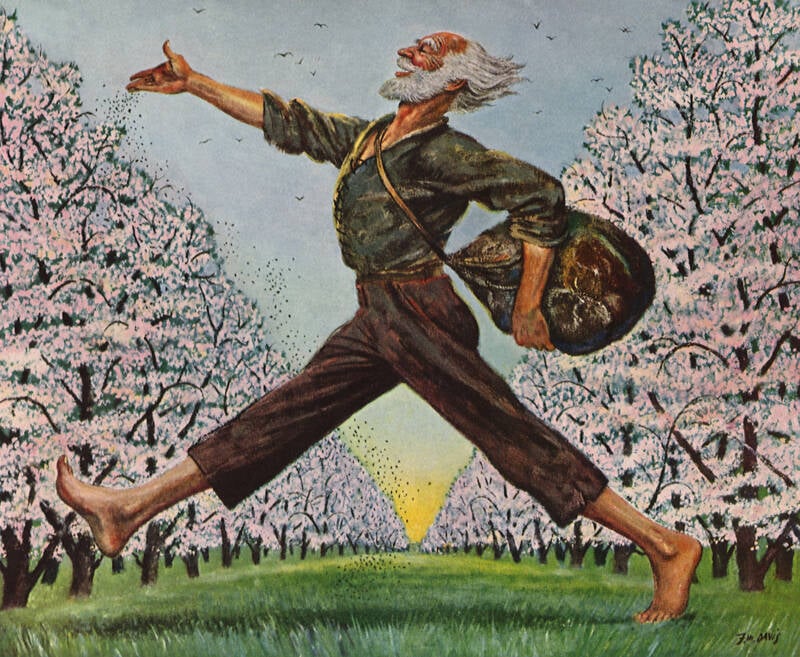 This would be a saint's day for us. Today is the birthday of John Chapman, better known to two centuries of American children as Johnny Appleseed; he was born on this day in 1774. Yes, he was a real person, and a far more interesting one than the Disneyfied stereotypes make him seem. John Chapman was a follower of the teachings of Swedish visionary and occultist Emmanuel Swedenborg, and spread Swedenborg's gospel as enthusiastically as he did apple seedlings. I did a blog post about him
 I'm far from sure how many people in the occult scene today have any idea just how scarce decent occult books were half a century ago. Yeah, I know, I sound like one of those geezers going on about how we had to walk two miles through the snow to get to school, and it was uphill both ways, blah blah blah -- and you kids get off my lawn! Seriously, though, between the stock market crash of 1929 and the first wave of serious occult reprints at the end of the 1970s, if you wanted anything that wasn't mass market schlock, you had to haunt used bookstores and write to hoodoo supply shops with names like Mar-Lar and Ty-Rad to get much of anything, and even then there wasn't much.
  It's a bit of a mixed bag. Sadhu, as we might as well call him, had the attitudes you'd expect from a mystically inclined Roman Catholic occultist, and it shows -- the section in one chapter about the horrible fate of masturbators is a masterpiece of unintentional comedy. (I wrote about that in an earlier blog
  It's nearly midnight and
 I was delighted to receive, via yesterday's mail, my hardback author's copies of The Life Force Workbook, the last of the seven volumes in the Golden Section Fellowship sequence. This volume rounds out a project that I first sketched out in the mid-1990s, and originally tried to get started in 2001. t's been a long and rocky road since then, with plenty of delays and one bitter disappointment, which adds more than a little to the sense of satisfaction I feel now. Now that it's complete, I want to talk a little bit about what it is, why it's so important a project to me, and why it offers the decidedly quirky take on occultism that it does.
  When I first began studying occultism in the 1970s, the field embraced a giddy exuberance of subjects and themes. Magic and divination, which have come to be treated as the be-all and end-all of occult studies in more recent years, rubbed shoulders with the whole panoply of alternative perspectives: lost continents, ley lines, yoga, breathing exercises, fad diets, natural healing methods, radionics, pyramid power, and the list just keeps on going. Some of this was straight-up quackery, but there was a lot that wasn't; some of it was seriously useful, and a lot more was at least entertaining.
  The 1980s brought retrenchment in that as in so many fields. In place of the wild diversity of perspectives of the previous decade, a particular mode of pop-culture Neopaganism (the version promoted so efficiently by Margot Adler, Starhawk, et al.) seized the collective imagination, and became something of a mental monoculture in what was left of the alternative scene; very nearly the only alternative history that mattered any more, for example, was the one in which the Pope personally burned nine million witches at the stake in Salem. (I exaggerate for effect, but only a little.) Outside the Neopagan movement, ceremonial magic became a central interest; this had impressive upsides, notably the revival of the Golden Dawn tradition and the beginning of serious work on translating and republishing older occult texts, but it also involved a dramatic narrowing of options.
  It was during this period, in the mid-1990s, that I first started brooding over the idea of a system of occult training and self-initiation that embraced at least a few of the themes of the broader field of the 1970s. I was already moving toward the fringes of the scene -- I'd put in most of two decades on Golden Dawn ceremonial magic by then, but I'd moved from there to studying the teachings of the Order of Bards Ovates and Druids, a Druid Revival order that embodied some of the older vision, which got me plenty of hate from the Celtic Reconstructionist faction of the Neopagans. I started collecting some of the books that had influenced me earlier in my studies; and I started to explore the possibility that occult training could be done using bodies of lore that weren't restricted to magic, divination, and dancing around in a circle stark naked while chanting "We All Come From The Goddess" and hoping to get laid. ;-)
 At the time I was also in the middle of my first serious studies of sacred geometry, and all that coalesced into a series of spiritual experiences where I saw a sequence of geometrical forms as the basis for a divination oracle and the foundation of a way of occult training. That became the basis of The Sacred Geometry Oracle, and it would have become the basis for a complete system along the lines of the current Golden Section Fellowship...except for one awkward little detail. The publisher I worked with in those days did editorial and marketing decisions via committee, and when The Sacred Geometry Oracle came before the committee, one of the members had just watched the movie The Matrix and came back burbling with enthusiasm, insisting that a deck that I'd intended to use as the basis for a sequence of books including earth mysteries and green spirituality ought to be done in an urban-noir style full of rusting metal, corroded concrete, and glow-in-the-dark neon.
  I objected to this. I was told, in so many words, to shut up and get with the program, that the publisher knew what they were doing and my concerns didn't matter. So an ugly, mangled version of my deck came out, and of course it flopped. I shelved the broader project and hoped that it might be possible some day to get back to it. By then I'd been suddenly landed with the job of taking a Druid order that was six inches from death on a slippery slope and getting it up on its feet again, and other concerns had to wait. If you want to know why my books on Druidry from that period all appeared from a different publisher, though, now you know.
  Time passed, the rights to The Sacred Geometry Oracle finally reverted to me, and after a few false starts I was able to place it with my current primary occult publisher, Aeon Books. It duly came out in a new and attractive edition, and found an audience. So I pulled out my old papers on the broader sequence, blew the dust off them, and went to work -- and here we are.
  It's nearly midnight and
 I'm delighted to announce that the first wave of submissions for Technonomicon: A Book of Forbidden Technologies was even more substantial than I'd hoped. The contributions I've already received amount to just short of 30,000 words, or about a third of the way to the length I had in mind. I haven't yet written my contributions -- I had some other things to get out of the way first! -- so once those are in, we'll very likely be to the halfway point.
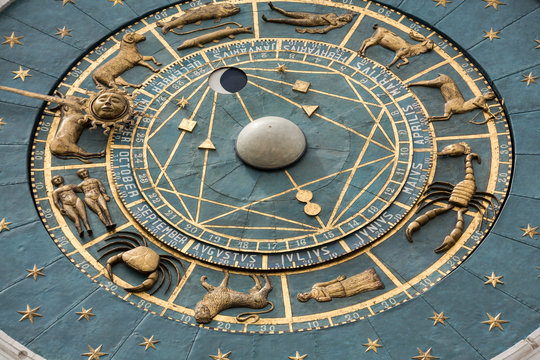 A heads up to occultists who share my interest in old-fashioned astrological magic -- my longtime friend Clifford Low, one of the pioneers of the modern revival of traditional astrological magic, has just launched a new website full of information on the subject at
  It's nearly midnight and
 I've had several people ask about tipping me for answers here, and though I certainly don't require that I won't turn it down. Because of issues with Ko-Fi and Buymeacoffee due to not having a smartphone, and because PayPal has cleaned up its act and stopped debanking people for political reasons, I've returned to asking people to tip there. On the other hand, if you're interested in political and economic astrology, or simply prefer to use a subscription service to support your favorite authors, you can find my Patreon page

