A venture into social macrobiotics
Nov. 5th, 2019 06:53 pm![[personal profile]](https://www.dreamwidth.org/img/silk/identity/user.png) ecosophia
ecosophiaI think most of my readers know that back in my teen years, when I was wet behind the ears and studied all kinds of odd things, I was into the macrobiotic diet for a while. (Those who joined us later will find my reflections on the subject here.) There were serious problems with the macrobiotic diet as it was presented in 1970s and 1980s America, and there were also some thoroughly bogus claims made for it -- as far too many people found out to their cost, no, eating a macrobiotic diet won't cure cancer, despite the claims that macrobiotic mavens Michio and Aveline Kushi made for it -- and Aveline Kushi herself demonstrated that the hard way by, yes, dying of cancer.
Go back behind the hoopla and the mistaken quest for perfect purity, though, and the core theory has some very useful insights to offer -- badly as those insights were often applied at the time. Over the years I've considered the possibility of a new macrobiotics, shorn of the overblown claims and certain other bad habits, oriented toward a broader and more balanced diet. That's a project for another time, but I had a curious insight this morning that suggests there might be something to it.
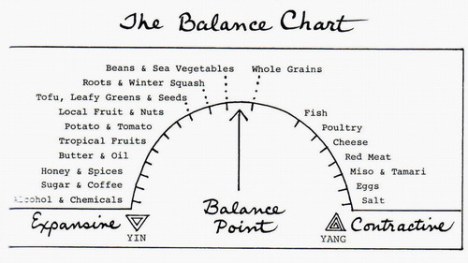 Basic macrobiotic theory, for those who haven't encountered it, derives from the ancient distinction between yin and yang. Yin, in macrobiotic terms, is centrifugal, expansive, diffusive, and spiritualizing; yang is centripetal, contractive, concentrative, and materializing. Different foods occupy different positions on a spectrum that extends from very yin to very yang -- for example, sugar is very far over to the yin end, and salt very far over to the yang end; tropical fruits are pretty yin while red meat is pretty yang, and so on. Grains are a little to the yang of center, beans and seaweed a little to the yin of center, and standard macrobiotic theory back in the day insisted that you should mostly eat those, with timid forays now and again to either side.
(That was the core mistake of the movement, for what it's worth. Anything that moves toward the center is yang, right? By moving their diets too far toward the center, macrobiotics practitioners embraced a serious yang imbalance that worked out in various ways, none of them helpful. A more balanced approach would have followed the basic rule of 3/5 yang and 2/5 yin -- that is, 3/5ths of the diet would be foods near the center, and 2/5ths would be food well out to the ends, with the same 3/2 preponderance of very yang to very yin. More on this later.)
Now let's compare this to another similar dichotomy, the distinction between the two kinds of evil in Rudolf Steiner's work. Steiner was among many other things a keen student of Aristotle -- as far as I know he was the most philosophically learned occultist we've had since the end of the Renaissance -- and he took from Aristotle's Nicomachean Ethics the insight that every virtue is not the opposite of one vice but the midpoint between two. (Thus courage, for example, is far from cowardice but it's also far from foolhardiness, generosity is equidistant from stinginess and from extravagance, and so on.) Steiner generalized this to posit two basic kinds of evil, which he called Ahrimanic and Luciferian evil. Ahrimanic evil is motivated by greed and lust, and seeks to drown the self in material experience; Luciferic evil is motivated by pride and envy, and seeks to flee from the material world into a realm of self-serving fantasy.
In macrobiotic terms, Ahrimanic evil is extreme yang -- it takes materialization to an unhelpful extreme. Luciferian evil is extreme yin -- it takes spiritualization to an unhelpful extreme.
Now notice how this relates to dietary prejudices in modern America.
 The diet of the self-proclaimed good people these days is overwhelmingly yin. Sweetened coffee drinks, tropical fruits, raw leafy greens, and meat substitutes made from tofu and the like play a massive role in such diet -- and what do you know, the most common distortions of thought and action on that end of society are those that Steiner considered Luciferian: rejection of physical reality (seen most clearly right now, perhaps, in the insistence that your gender consists of whatever you say it does), scornful condemnation of those too seen as being too close to the world of matter (cough, cough, basket of deplorables, cough, cough), obsessive fantasies of escape from the world of mere matter (whether New Age or transhumanist), and so on.
 Meanwhile researchers scramble around frantically promoting studies that claim that salt is bad for you and that salted red meats -- bacon is the usual target here -- are really, really bad for you. (Even though the evidence, if you wade past the sort of dubious statistics that have made the phrase "replicability crisis" a persistent presence in dietary research, doesn't really support either claim.) Talk about "toxic mascuilinity" (a label for extreme yang behavior) is all over the corporate media, but heaven help you if you point out that "toxic femininity" (which would be an equally good label for extreme yin behavior) is at least as prevalent, and at least as problematic.
So a population that eats a seriously yin diet has exactly the sort of ethical and psychological problems that macrobiotic principles would suggest. No wonder eating bacon has become one of the standard ways that people who want to distance themselves from the self-proclaimed "good people" do so.
Now of course a diet overloaded with yang foods would be just as problematic as one overloaded with yin foods. Far more healthy would be a diet that balances the extremes against the middle -- say, a bacon cheeseburger and a tossed salad with croutons. Hungry yet? ;-)
Go back behind the hoopla and the mistaken quest for perfect purity, though, and the core theory has some very useful insights to offer -- badly as those insights were often applied at the time. Over the years I've considered the possibility of a new macrobiotics, shorn of the overblown claims and certain other bad habits, oriented toward a broader and more balanced diet. That's a project for another time, but I had a curious insight this morning that suggests there might be something to it.
Basic macrobiotic theory, for those who haven't encountered it, derives from the ancient distinction between yin and yang. Yin, in macrobiotic terms, is centrifugal, expansive, diffusive, and spiritualizing; yang is centripetal, contractive, concentrative, and materializing. Different foods occupy different positions on a spectrum that extends from very yin to very yang -- for example, sugar is very far over to the yin end, and salt very far over to the yang end; tropical fruits are pretty yin while red meat is pretty yang, and so on. Grains are a little to the yang of center, beans and seaweed a little to the yin of center, and standard macrobiotic theory back in the day insisted that you should mostly eat those, with timid forays now and again to either side. (That was the core mistake of the movement, for what it's worth. Anything that moves toward the center is yang, right? By moving their diets too far toward the center, macrobiotics practitioners embraced a serious yang imbalance that worked out in various ways, none of them helpful. A more balanced approach would have followed the basic rule of 3/5 yang and 2/5 yin -- that is, 3/5ths of the diet would be foods near the center, and 2/5ths would be food well out to the ends, with the same 3/2 preponderance of very yang to very yin. More on this later.)
Now let's compare this to another similar dichotomy, the distinction between the two kinds of evil in Rudolf Steiner's work. Steiner was among many other things a keen student of Aristotle -- as far as I know he was the most philosophically learned occultist we've had since the end of the Renaissance -- and he took from Aristotle's Nicomachean Ethics the insight that every virtue is not the opposite of one vice but the midpoint between two. (Thus courage, for example, is far from cowardice but it's also far from foolhardiness, generosity is equidistant from stinginess and from extravagance, and so on.) Steiner generalized this to posit two basic kinds of evil, which he called Ahrimanic and Luciferian evil. Ahrimanic evil is motivated by greed and lust, and seeks to drown the self in material experience; Luciferic evil is motivated by pride and envy, and seeks to flee from the material world into a realm of self-serving fantasy.
In macrobiotic terms, Ahrimanic evil is extreme yang -- it takes materialization to an unhelpful extreme. Luciferian evil is extreme yin -- it takes spiritualization to an unhelpful extreme.
Now notice how this relates to dietary prejudices in modern America.
The diet of the self-proclaimed good people these days is overwhelmingly yin. Sweetened coffee drinks, tropical fruits, raw leafy greens, and meat substitutes made from tofu and the like play a massive role in such diet -- and what do you know, the most common distortions of thought and action on that end of society are those that Steiner considered Luciferian: rejection of physical reality (seen most clearly right now, perhaps, in the insistence that your gender consists of whatever you say it does), scornful condemnation of those too seen as being too close to the world of matter (cough, cough, basket of deplorables, cough, cough), obsessive fantasies of escape from the world of mere matter (whether New Age or transhumanist), and so on.Meanwhile researchers scramble around frantically promoting studies that claim that salt is bad for you and that salted red meats -- bacon is the usual target here -- are really, really bad for you. (Even though the evidence, if you wade past the sort of dubious statistics that have made the phrase "replicability crisis" a persistent presence in dietary research, doesn't really support either claim.) Talk about "toxic mascuilinity" (a label for extreme yang behavior) is all over the corporate media, but heaven help you if you point out that "toxic femininity" (which would be an equally good label for extreme yin behavior) is at least as prevalent, and at least as problematic. So a population that eats a seriously yin diet has exactly the sort of ethical and psychological problems that macrobiotic principles would suggest. No wonder eating bacon has become one of the standard ways that people who want to distance themselves from the self-proclaimed "good people" do so.
Now of course a diet overloaded with yang foods would be just as problematic as one overloaded with yin foods. Far more healthy would be a diet that balances the extremes against the middle -- say, a bacon cheeseburger and a tossed salad with croutons. Hungry yet? ;-)


(no subject)
Date: 2019-11-06 02:33 am (UTC)(no subject)
Date: 2019-11-06 03:21 am (UTC)(no subject)
Date: 2019-11-06 02:52 am (UTC)The first is how does this yin/yang dichotomy square with your Driuidic third way? Unless balance is the third way?
Second, does this apply to exercise? On the yin side would be... yoga, pilates, Zumba etc. on the yang side weightlifting, martial arts, extreme sports?
(no subject)
Date: 2019-11-06 03:27 am (UTC)2) On the yin side would be relaxation exercises, massage, stretching, and internal martial arts such as t'ai chi. On the yang side would be calisthenics, weightlifting, competitive sports, and external martial arts such as Shaolin kung fu.
(no subject)
Date: 2019-11-06 09:09 am (UTC)(no subject)
Date: 2019-11-06 07:51 pm (UTC)The thing to keep in mind is that macrobiotics isn't really an Asian system. Its founder's self-given name is a French pun ("Oh, ça va!" is roughly "Oh, I'm doing fine!") and while he drew the basics from Japanese alternative culture, he developed the system while living in France and drew heavily on ideas that were current in the French alternative scene. In its mature form, as found (for example) in the writings of Michio Kushi, it contains a great deal of Western occult philosophy as well. I use it simply because it works, in odd ways, and when pruned of some of its dysfunctional aspects.
Which yin and yang?
From: (Anonymous) - Date: 2019-11-07 03:11 am (UTC) - ExpandRe: Which yin and yang?
From:Re: Which yin and yang?
From: (Anonymous) - Date: 2019-11-08 02:39 am (UTC) - ExpandRe: Which yin and yang?
From:(no subject)
Date: 2019-11-06 11:56 am (UTC)(no subject)
Date: 2019-11-06 07:51 pm (UTC)(no subject)
From: (Anonymous) - Date: 2019-11-06 11:04 pm (UTC) - ExpandMy Friend the pig
Date: 2019-11-06 02:21 pm (UTC)I have always tried to use meat as almost a condiment. Chicken and Rice with rice predomimationg. Chili with Pork with beans predominating.
What I don't get is does the mere inclusion of a Yang food in small quantities balance the Yin? Or to balance do I have to use some kind of equivalence table published soemwhere?
You thoughts are intriguing, not enough so to make me change my well-set ways, but enough so to see if I can rationalize my diet preferences to my more ethereal friends.
Good post, made me smile a non-toxic masculine smile
Re: My Friend the pig
Date: 2019-11-06 07:56 pm (UTC)mcarobiotics
Date: 2019-11-06 04:20 pm (UTC)Another problem I had with the diet is that the literature said that certain foods created mucus in organs that to the best of my knowledge have no mucus producing cells--such as the kidneys. Since Buddhist cultures do not commonly practice dissection of human bodies it was not clear to me where the idea would come from that a disease was caused by "mucus in the kidneys" etc. Perhaps this was a translation problem and the concept was something that could have been translated as "congested energy (chi?) in the organ" rather than a physical substance.
Macrobiotics is not the only diet with a concern over mucus--I seem to recall that some Western diet fads had a similar concern. This seems to be a confusion of cause with effect. Mucus is the body's effort to sooth or protect certain tissues--an excess reveals some source of irritation, not that the mucus itself is the problem. Just trying to eliminate mucus, or fever or other reactions to disease is like shooting at firemen because they always seem to be around when there is a fire.
Another idea was that this was based on the practice of monks--which made no sense to me since Buddhist monks traditionally lived by begging. How would they have any control over their diet if they were supposed to humbly accept what was offered? The spiritual health of humility is not the same concept as physical health from yin/yang balance IMO.
There were some inspiring Macrobiotics "cured my cancer after the doctors gave up" tales circulating back in the day. My personal interpretation is that any extreme change in lifestyle can trigger a healing crisis in some people. Sort of the body saying "Oh, you really want to live? Well why didn't you say so. We can do that." For some the change is a trip to Lourdes or some other religious test, for some a severe change in diet or some other aspect of their lifestyle. But as you noted, it doesn't work for everyone. Dr. Weil, whose work I had a lot of respect for before he started selling cosmetics, noted that new healing systems, such as chiropractic, osteopathy, extreme diets, etc. seemed to be more effective in their early years than later. So maybe some people require some "kick to the head" to trigger a healing crisis?
Re: mcarobiotics
Date: 2019-11-06 07:59 pm (UTC)Re: mcarobiotics
From: (Anonymous) - Date: 2019-11-12 05:59 pm (UTC) - ExpandIs yin really the problem?
Date: 2019-11-06 07:37 pm (UTC)I'm an omnivore and try to eat in as balanced a way as possible (with the occasional French fry thrown in), but given these numbers, can we really say that a universally overloaded yin diet is the problem? Or is <5% of yin eaters in America enough to account for extreme yin behavior?
Sources:
https://animalcharityevaluators.org/blog/is-the-percentage-of-vegetarians-and-vegans-in-the-u-s-increasing/
https://cdn.knightlab.com/libs/timeline3/latest/embed/index.html?source=1zG9HnTaxLUxgRiTS2PIuLtWRKXCy0Si_xiwNHfC1IT4&font=Default&lang=en&timenav_position=top&initial_zoom=1&height=900
https://en.wikipedia.org/wiki/Vegetarianism_by_country
https://nypost.com/2018/10/26/one-third-of-americans-consider-themselves-flexitarian/
https://www.seattletimes.com/business/americans-meat-consumption-set-to-hit-a-record-in-2018/
Re: Is yin really the problem?
Date: 2019-11-06 08:02 pm (UTC)Re: Is yin really the problem?
From: (Anonymous) - Date: 2019-11-07 04:25 am (UTC) - ExpandRe: Is yin really the problem?
From:Re: Is yin really the problem?
From: (Anonymous) - Date: 2019-11-08 02:20 pm (UTC) - Expand(no subject)
Date: 2019-11-06 09:40 pm (UTC)A few years ago I took in about 30 or 40 hours worth of talks by the American Taoist priest Liu Ming. I had, by this point, become fairly familiar with Taoist philosophy, and I was always confused by the way that Ming also reversed the meanings of Yin and Yang. He regularly described Heaven as Yin and Earth as Yang, for example. I never understood this, and still wonder where he got it.re
I eventually stopped listening to Liu Ming's talks, though, and stopped reading anything at all by him. His worldview, and teh version of taoism he shared, felt incredibly cold and dead, like a grey sheet of metal in which the bright colors that so enliven classical Taoism as described in other sources were just very faintly reflected. For Ming, the demonic was Yang Excess; he claimed that the proper ratio of Yang to Yin was actually about 1:1,000 in favor of Yin. Anything more risked chaos, cancer or even spirit possession. He regularly condemned, in a smug, mocking tone, everything from the wearing of shorts to any exercise that induced sweat to backpacking in the wilderness (it's full of demons) to spending time on the beach. One should spend one's time, rather, eating rice and practicing the dullest variation on zuowang meditation imaginable. Eventually I found just thinking about his ideas to be somewhat nausea-inducing, and stopped interacting with things Chinese in general.
I've puzzled to make sense of this experience, but this post has given me a framework in which to do so. For Liu Ming, as I said-- and I'm quoting him-- the demonic is Excess Yang. If we accept the formulation of Yang=Material, Yin=Immaterial, then what he was talking about is Ahrimanic evil. That Yin Excess could be equally demonic doesn't seem to have occurred to him-- and no wonder, since his stripped-down, boring, austere, deeply condescending, gray walls and tofu Taoism is the embodiment of just that sort of evil. Luciferic Evil, as opposed to the Ahrimanic.
...
Complicating the story, though, at the same time that I was listening to Liu Ming's talks, I was also listening to dozens of hours of talks by a very different priest-- Father Chad Ripperger, a Traditional Roman Catholic priest and exorcist of the Priestly Fraternity of Saint Peter. I was looking for information on spirit possession, you see, from firsthand sources. Both men were intolerable in their own way, but I found I could use them as a binary which I could resolve into a ternary by ignoring all the nasty stuff. Both were strident in their condemnation of other traditions. In a very real sense, both were Luciferic, as we're using the term here. But it was a different source of Luciferianism. Ming's was a Luciferianism of contemptuous withdrawal from the world. Fr. Ripperger's was one of aggressive engagement with the world-- to ensure its universal subsumption into the Catholic Church. So both of these were Luciferic, which we're calling Yin here. But I wonder if we could say that Ming's was actually more of a Yin (passive) Luciferianism, while Ripperger's was more of a Yang (active) Luciferianism?
And that further suggests that there would be Yin and Yang variations of Ahrimanism. I wonder what that would look like.
(no subject)
Date: 2019-11-06 11:51 pm (UTC)(no subject)
Date: 2019-11-06 09:52 pm (UTC)Two opposing forces will, depending on their variation with time, cause stagnation or oscillation. It can be entertaining for a while, but it can also make you seasick. And if the forces are too strong compared to friction of the system....
By the way all that talk about bacon and burgers is kind of mean! Close to midnight and no burgers in sight! ;-)
Nachtgurke
(no subject)
Date: 2019-11-06 11:54 pm (UTC)1. Bacon
2. Ground beef
3. Cheese
4. Lettuce
5. Tomato
6. Hamburger buns
7. Ladies' clothing
;-)
(no subject)
From: (Anonymous) - Date: 2019-11-07 12:54 pm (UTC) - Expand(no subject)
From: (Anonymous) - Date: 2019-11-07 02:16 pm (UTC) - ExpandTriune System of Scientific Eating
Date: 2019-11-06 10:20 pm (UTC)For what it’s worth, I’m very interested in seeing a fully developed “new macrobiotics”!
Re: Triune System of Scientific Eating
Date: 2019-11-06 11:55 pm (UTC)(no subject)
Date: 2019-11-06 11:14 pm (UTC)What do you think of the concept of eating in line with your blood group? Os are the carnivores and As are the vegetarians. What I like is it acknowledges that we don't all thrive on the same diet.
https://www.webmd.com/diet/a-z/blood-type-diet
(no subject)
Date: 2019-11-06 11:57 pm (UTC)2) It doesn't work for me. I'm type A and I don't process vegetable proteins effectively -- I need animal protein in my diet or I start looking anemic and my immune system gets weak.
(no subject)
From:Diet and Caste
Date: 2019-11-07 02:13 am (UTC)Your associating the over-consumption of yin/expansive foods with the views of America’s “good people” and Luciferian evil appears to be a good fit. But, of course, if there is a relationship between foods and attitudes, it should be borne out in other cultures as well. Using the example I know best – the Hindu caste system – let’s take a look.
Traditional Hindu society is divided into four groups: the Brahmins (priests & scholars), Vaishyas (merchants), Kshatriyas (royalty and warriors), and Shudras (labourers and servants).
According to the scriptures, the first two castes listed above (Brahmins and Vaishyas) are to subsist on a vegetarian diet and for Brahmins alcohol is forbidden. That makes these two groups prone to excessive ‘yin’ and therefore Luciferian evil. This fits well with Brahmins because their main objective in life is moksha (liberation from the cycle of birth and death) and merging with the divine; and are often prone to pride of birth, scholarship and their spiritual attainments. Vaishyas, on the other hand, are prone to envy (market competition?) but also greed (a facet of Ahrimanic evil): could perhaps a vegetarian diet have been advocated for this group to minimize their propensity towards greed?
The other two castes – Kshatriyas and Shudras – are permitted to eat flesh, presumably due to the physical fitness required for fulfilling their duties/professions. Certainly, the Ahrimanic duo of greed and lust fit both castes: the warriors fulfill them through effort (conquest!) and the servants through slothfulness or devious means.
(Huge caveat: what I am describing above is as per Hindu scripture and is therefore idealized; therefore, neither the virtues and vices that dwell in every human being nor the spectrum of differences among individuals within each caste – which is the reality – are covered. Just the same, having been continuously surrounded by Hindus for the past four decades and seeing Hindu individuals through the lens of caste, I find that the link between diet and “type of evil” seems to fit fairly well)
So, in a long-winded way, I am saying that believe you are onto something, JMG! Also, thanks for bringing up the term “toxic femininity”: though “masculine” is equated with “evil” these days in much of present-day society (cue to Red Green’s men’s prayer: “I am a man, but I can change… if I have to… I guess”), males have yet to corner the market on toxicity!
Ron M
Re: Diet and Caste
Date: 2019-11-07 06:45 am (UTC)The relationship between diet and caste is interesting, not least because Hindu culture has been around long enough to pay attention to such things. As for "toxic femininity," it struck me as past time that got a convenient label. What's sauce for the gander...
Toxic feminitity
From:Re: Toxic feminitity
From:Re: Toxic feminitity
From: (Anonymous) - Date: 2019-11-07 07:21 pm (UTC) - ExpandRe: Toxic feminitity
From: (Anonymous) - Date: 2019-11-08 01:07 am (UTC) - ExpandRe: Toxic feminitity
From: (Anonymous) - Date: 2019-11-07 09:56 pm (UTC) - ExpandRe: Toxic feminitity
From:Re: Toxic feminitity
From:Re: Toxic feminitity (or masculinity)
From:Re: Toxic feminitity
From: (Anonymous) - Date: 2019-11-08 10:00 pm (UTC) - Expand(no subject)
Date: 2019-11-07 10:10 pm (UTC)(no subject)
Date: 2019-11-08 01:06 am (UTC)(no subject)
Date: 2019-11-07 11:08 pm (UTC)(no subject)
Date: 2019-11-08 01:08 am (UTC)(no subject)
Date: 2019-11-08 12:52 am (UTC)(no subject)
Date: 2019-11-08 01:10 am (UTC)X r size
Date: 2019-11-08 01:56 pm (UTC)Re: X r size
Date: 2019-11-08 06:19 pm (UTC)(no subject)
Date: 2019-11-08 04:34 pm (UTC)(no subject)
Date: 2019-11-08 06:20 pm (UTC)(no subject)
From: (Anonymous) - Date: 2019-11-08 08:38 pm (UTC) - Expand(no subject)
From:A balanced lunch -
Date: 2019-11-08 11:42 pm (UTC)Re: A balanced lunch -
Date: 2019-11-09 03:17 am (UTC)Questions
Date: 2019-11-09 05:27 pm (UTC)1. Did the graphic you posted come from The Self-Healing Cookbook by Kristina Turner? The same graphic is in my copy of that book. I got the book because my sister became interested in macrobiotics a couple of decades ago. It was brief on her part, and I didn't take it up because my husband is the main cook at home and he wasn't interested in trying it. But I kept the book for some reason.
2. Where does the basic rule of 3/5 yang and 2/5 yin come from? If it was in your post, I missed it.
I'm not sure if I predominate in either yin or yang, based on what you've written. I do notice that my husband and I eat somewhat differently. He likes cheese more than I do and eats more of it, while I eat more yogurt. I eat a higher proportion of grains to meat than he does, plus we prefer different meats. I also like sugar and chocolate more than he does. Presumably chocolate (and tea, which I also like a lot) are way yin on this scale.
I'm intrigued, and will be interested in your further thoughts on the matter.
Re: Questions
Date: 2019-11-09 08:29 pm (UTC)2) I was taught that rule as basic macrobiotic theory; I'm pretty sure it's in Michio Kushi's books, since that's who most of the macrobiotics people I studied with used as their guide, but I couldn't swear to it. In practice, it wasn't followed precisely -- you just made sure it was "more yang than yin, but not too much more," and watched to see how the results affected your body for fine tuning.
Chocolate is quite yin but tea varies. Ordinary black or oolong tea is mildly yang and considered very good for you. Kukicha, which is made from twigs, is more yang and is good when you have to counterbalance a yin condition; a lot of people I know drank it by preference. Ordinary green tea is just a bit yin, but very near the middle; it was also considered very good for you, especially for people who tend to unbalance in a yang direction. Some of the people I knew would consider your fondness for tea and grains to be a good sign -- "it shows that your body is trying to balance itself" was a line I heard fairly often.
Re: Questions
From:Re: Questions
From:Re: Questions
From:My macrobiotic experience
Date: 2019-11-11 02:42 pm (UTC)My first experience with something like a macrobiotic diet happened in my early 30s, when a doctor I was working with convinced me to try his version of the “wide” diet: whole boiled grains, fresh vegetables steamed or stir-fried, tofu, tempeh, and occasional fresh fish. It helped me identify some food sensitivities (e. g., milk and its products) but I didn't stay with it because it was too socially restrictive and, when I was on the road, getting the ingredients was too difficult.
Fast forward twenty-some years. As my body approached menopause, I developed a problematically large uterine fibroid. Doctors estimated its size at 5-6 pounds, if it was all one tumor and not a bunch of them. Because of that latter possibility, neither of the ob/gyns I consulted was willing to promise me that they wouldn't perform a hysterectomy when removing it surgically. So I decided to look around for alternative methods. At the time I was living in western Massachusetts, within an hour's drive of the Kushi Institute. Certified macrobiotic consultants were thick on the ground, so I hired one to give me a fibroid-reduction plan.
The plan included some basic macro stuff that I hadn't done before, such as cooking my food over actual flame instead of the electric stove (I made every meal on the Hibachi in the yard for four months) but also some custom dietary rules. I was to never eat anything baked, to avoid all nuts, seeds, and fruit including foods that are biologically fruit even though we eat them as vegetables, and to eat daikon radish every day. Do you know about the role of daikon in Japan's Steel Penis festival? The root can grow to the size of a man's forearm, and it is traditionally carved into penis shapes which are carried through the streets in processions. On a symbolic level, what this consultant recommended was that I throw all the pregnancy and child symbols out of my diet and add this vegetable with famous phallic associations.
But that's not all. There were two other things he told me to throw out of my diet: animal products and fats.
It did bring the fibroid down to the point where it wasn't pressing on my other organs. But there were other results as well, which I was very slow to connect to the diet, mainly because they were very slow to come on.
One was that I began to crave fatty foods, even though the fat was pretty obviously going right through me. The other was that I began to have back troubles. I couldn't sit all day the way I used to. It became a real problem. I tried another diet: raw vegan this time. It didn't help, although it was in a raw vegan support group that I heard, for the first time, criticism of macrobiotics, particularly that it failed to support all-around health because it didn't have enough fat.
The turning point came at a friend's retirement party. I complained about what I was going through to a relative of the guest of honor. She turned out to know something about it. She said, “You've lost your ability to digest fat.” Now, I already knew that it was possible to lose the ability to digest animal protein. In fact, it happens automatically after about five weeks of veganism. Once it has happened, animal foods have to be carefully reintroduced to avoid some really miserable symptoms. I already knew this both from my reading and from hard experience. So I asked for more information, only to be told that recovering the ability to digest fat is more complicated and requires the help of a trained nutritional consultant.
Fortunately, I was able to find one. She put me on a two-month regimen of assorted pills, which resolved, not just the craving, but also the back pain, which I had not until then associated with my fat digestion issue.
A few years later, I ran across a book called The Vegetarian Myth. It's an anti-vegetarianism book, divided into three subjects: the politics and economics of food production, the heath effects, and the author's own story. She was amazingly stubborn, sticking with vegetarianism for over twenty years even as her health deteriorated to the point where she was actually legally disabled. Her back pain sounded a lot like my back pain, or what my back pain might have turned into if I hadn't had the good luck to find a remedy at an early stage. And she also spent a long paragraph denouncing low-fat diets, although she did not explicitly connect the low-fat factor in her diet with her symptoms. I left a long comment on the book's Amazon page.
Also, in The Vegetarian Myth, there are some interesting details about the mental health issues she noticed among her fellow vegetarians and vegans. In particular, she observed that a high-soy vegan diet tended to make people ranty and disinclined to listen. So maybe the behavior you noted in “Dancers at the End of Time, Part 1” where people would simply fail to engage with your talking points, had something to do with the current fashionability of vegan diets for carbon footprint reduction.
Re: My macrobiotic experience
Date: 2019-11-11 10:17 pm (UTC)(no subject)
Date: 2019-11-11 03:36 pm (UTC)There is much propagandizing on each extreme of the spectrum, and sorry to hear (from a previous post) you were the target of public shaming attempts because of what you had in your shopping cart. Given my extraction (Mediterranean), I find myself doing fine on a mostly vegetarian diet with extremely limited intakes of meat, dairy, and sugar. But that's me.
One aspect not often considered is how our diets relate to the modern world and its "any type of food right now" mentality, which is only possible given a stable supply of fossil fuels. Most traditional diets emerge from the hard physical limitations of the culture it arose from--the traditional American meat 'n potatoes diet included. The easy access to food we enjoy these days has opened the question of what we "should" do, which doesn't necessarily make sense, thus phrased.
Salve et axé
(no subject)
Date: 2019-11-11 10:19 pm (UTC)Non-dietary applications?
Date: 2019-11-12 06:17 am (UTC)More to the point I want to drive at, does this idea (1) seem applicable to any arena, as long as one identified how "yin" and "yang" any particular activity is? And (2) leaving aside the exact proportions for now, is this already something Macrobiotics or some other systems (e.g. Daoism) already advise?