Shoggoths: A Briefing Paper
Jan. 22nd, 2019 01:43 pm![[personal profile]](https://www.dreamwidth.org/img/silk/identity/user.png) ecosophia
ecosophia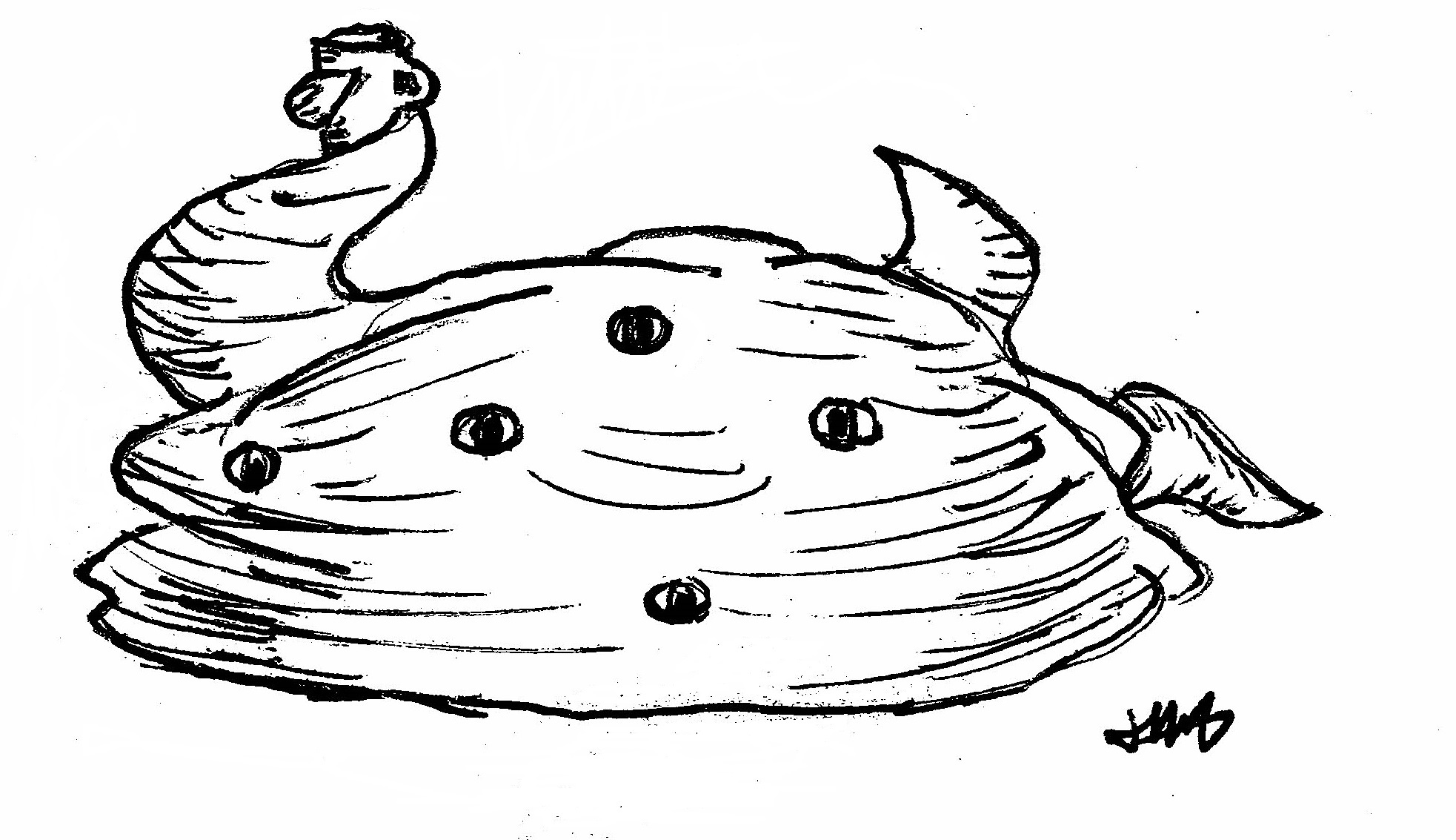 By reader request, I'm posting a paper on shoggoths I drew up for a reader who's doing a roleplaying game based on my fantasy series The Weird of Hali. These are not your common or garden variety Lovecraftian shoggoths, of course, nor are they the shoggothoid things that feature these days in anime and manga; they're the shoggoths found as a minor presence in The Weird of Hali and at center stage in my as-yet-unpublished novel The Shoggoth Concerto and its as-yet-unfinished sequel The Nyogtha Variations.
 Yes, that's a picture of a small shoggoth; yes, I drew it; and yes, that's a coffee cup in its pseudopod. Shoggoths generally don't like coffee -- they dislike strong bitter flavors -- but hot chocolate is quite another matter. With that said...
Shoggoths
Description and Biology
At first glance a shoggoth resembles a heap of iridescent black soap bubbles dotted with pale greenish eyes, which appear and disappear at intervals. Closer examination reveals an outer layer, the mantle, which looks gelatinous but is actually cool and dry to the touch, surrounding the black organules within. Shoggoths can reshape themselves at will and produce specialized organs as needed from their organules; they breathe through pores in the mantle, and are equally comfortable living on land or in water. They produce small mouthlike orifices to communicate, and can feed on any organic matter, which they engulf whole.
Shoggoths were created by the Elder Things in various sizes for different purposes. The largest, found only in Antarctica at present, were created for heavy construction projects and are around fifteen feet in diameter when contracted into a sphere. The most common variety in North America, created for ordinary labor, ranges from eight to ten feet in diameter, but there are also North American populations of small shoggoths, averaging four feet in diameter, which were created as household slaves.
Shoggoths reproduce asexually by budding.(1) Depending on the available food supply and certain other environmental factors, from one to eight broodlings will bud at a time from a single shoggoth. All shoggoths are potentially fertile from the time of full maturity into advanced old age, though most have one or two broods over the course of their lifespan. Because shoggoths do not have the concept of number, estimates of their lifespan are uncertain at best; Deep One records suggest that a lifespan of something like one century is not unusual.
Broodmates—those shoggoths who bud at the same time from the same broodmother—form close emotional bonds, and have some degree of telepathic contact: for example, if one shoggoth learns to recognize the scent of another being, all its broodmates will be able to do so at once. While shoggoths do not have sex, there are certain forms of intimacy among them that involve an exchange of fluids, and these intimacies are only socially acceptable between broodmates. While it does occasionally happen that shoggoths not of the same budding have such a relationship, it’s considered shameful and not something to be discussed in front of broodlings.
Scent in shoggoths plays much the same role that facial expression does in human beings, as an indicator of emotional state. A scent like Brie cheese indicates ordinary calm; a scent like freshly washed mushrooms indicates happiness, and a scent like bread fresh from the oven indicates affection. On the other side of the spectrum, an acrid smell indicates fear, a sharp bitter scent indicates grief, and an ammonia scent tells of illness. A fetid, choking stench is the “moisture-of-war,” a toxic secretion used in combat situations, and also indicates anger.
Because shoggoths reproduce asexually, and each broodling is literally a separated portion of the flesh of its broodmother, there is no crossbreeding among them and the characteristics of each lineage remain unchanged over geological time spans. Each of the shoggoth kinds, from the huge shoggoths of Antarctica to the small shoggoths of the New Jersey hills, thus has its own distinctive character and traditions.
History and Society
As mentioned above, shoggoths were created by the Elder Things as a slave species. They were treated badly enough by their masters that they rebelled during the global troubles at the end of the Permian era, and for more than six thousand years fought an unsuccessful war for freedom. Hundreds of millions of shoggoths were slaughtered during the suppression of the rebellion, using molecular disintegrators and other high-tech weaponry, and the treatment of the survivors was brutal in the extreme.
During the Triassic era that followed, the Elder Things set out to counter the growing influence of Cthulhu and his octopoid spawn by creating a slave-being of roughly the same power as a Great Old One. Their labors succeeded, and they created Nyogtha. Their treatment of Nyogtha was no better than their treatment of the shoggoths, however, and Nyogtha also rebelled against them; the struggle between Nyogtha and the Elder Things brought about the extinction crisis between the Triassic and Jurassic eras. Nyogtha was defeated but he could not be destroyed or forced back to subservience, and he took refuge in the deep places of the earth. The Elder Things, appalled by their own creation, called Nyogtha The Thing That Should Not Be, and he took that title for his own as a sign of his contempt for his creators.
Craving vengeance, he made contact with the shoggoths, and he and they made a pact of mutual assistance. Under his guidance, the shoggoths carried out a campaign of subversion, sabotage, and poisoning against the Elder Things. This campaign eventually succeeded in driving the Elder Things into extinction.(2) The pact between Nyogtha and the shoggoths is in effect the shoggoth religion; shoggoths perform certain rites that give Nyogtha life and strength, and in return Nyogtha protects the shoggoths against their enemies and advises them. Shoggoths are aware of the Great Old Ones and respect their power, but do not worship them.
Long before the last Elder Thing city in Antarctica was laid waste, shoggoths who escaped from Elder Thing control established colonies in various parts of the world. Shoggoth colonies are invariably underground, and comprise networks of caverns, the walls of which are carved with the bold abstract designs of shoggoth art. Colonies tend to be located in areas where there are extensive deposits of brown coal, which shoggoths find quite palatable as food; organic matter from the surface is also a significant part of the diet in some colonies. Shoggoth colonies are governed by a loose collection of elders who interpret a body of traditional law.
Shoggoths are sociable by nature and normally live in large groups. Their sense of appropriate personal space involves close physical contact—in a shoggoth colony, those shoggoths not otherwise occupied can typically be found nestled together in a squirming communal heap abuzz with conversation. As a result, where you find one shoggoth, you are likely to find others.
Psychology and Culture
Shoggoths are roughly as intelligent as human beings, and thus, like us, fall toward the bottom end of the intelligence spectrum among sentient beings. Their language consists of whistled musical notes across a range of three or four octaves; this language (a simplified form of the language of the Elder Things) is genetically programmed into them, and broodlings can speak within weeks of budding. They can also learn to speak other languages, though this takes them about as much effort as it would take a human adult to learn a new language. Human beings can learn the shoggoth language without too much difficulty, as it is straightforward and logical in its structure; due to its musical nature, human musicians have a particularly easy time.
Shoggoths are literate, using the dot-syllabary of the Elder Things for written records and carvings. Their arts include music and poetry—these two are not distinguished, due to the musical nature of the shoggoth language—and a particular kind of sculpture: shoggoths like to carve long bands of abstract patterns along the walls of tunnels and caverns, borrowing a habit o the Elder Things and repurposing it for their own uses. These carvings are experienced and enjoyed by touch, not by sight; as a shoggoth slides past the carving, a pseudopod pressed against it feels the patterns as vibrations. The experience is apparently something like what humans experience when listening to instrumental music.
The most significant differences between shoggoth and human intelligence are threefold. First, shoggoths are much less fond of innovation than humans. So long as they have safe and comfortable places to live, an adequate food supply, and freedom from interference by other species, they see no need to change. As a result, shoggoth culture remains the same across tens of millions of years: epic songs about their struggle against the Elder Things, which were composed in the Mesozoic, are still taught to shoggoth broodlings as a central part of their education.
The second main difference is that shoggoths have no concept of mathematics, or even of numbers. A very few shoggoths, after long association with other beings, have picked up a basic facility with numbers, but this takes them roughly the same level of effort that you or I would need to understand Einstein’s theory of general relativity. Where we see numbers, they see patterns; a shoggoth artist can carve a precise pentagon on a wall, but could not tell you how many points it has. The pentagon to them is a shape, not a number of angles.
The third difference is a rather more flexible sense of personal identity. Shoggoths have names only when they are around other shoggoths, and take a new name every day—it’s a normal courtesy in shoggoth society to greet a newcomer with “My name today is Across the Cavern,” or whatever it happens to be that day. Shoggoths who are acquainted with humans consider the human habit of having one name throughout one’s life to be exceedingly strange, as strange as always eating through the same orifice or seeing through the same eyes.
Combat
Shoggoths are extremely strong and fast, far more so than most beings of equivalent size. Even the smallest variety of shoggoth can disarm, kill, and dismember a human being in a matter of seconds. Their usual method of attack is to seize the nearest available portion of an opponent’s body and tear it off. They are effectively invulnerable to hand-to-hand weapons such as knives and clubs—they can stiffen their mantles to the consistency of armor plate—and bullets simply annoy them. Flamethrowers can be effective against small and midsized shoggoths, but it takes high explosives, incendiary bombs, or high-voltage electricity to kill them reliably.
Shoggoths in combat secrete a fluid they call “moisture-of-war,” which coats their bodies. It has a fetid, choking scent, and is toxic to most other beings, though not to shoggoths. Its effect on humans is comparable to tear gas; it is also extremely slippery, making attempts to seize even the smallest broodling an exercise in futility. (Attempting to seize a broodling is also foolhardy for another reason, as its broodmother will react the way a mother grizzly would respond to a threat to her cub. Humans who try this can expect to be dismembered quite literally joint by joint.)
Despite their effectiveness as fighters, shoggoths are not especially belligerent. They normally ignore human beings and other intelligent species, though some shoggoth colonies trade with humans, voormis, and Deep Ones. The usual pattern here involves gifts of food to the shoggoths; while shoggoths can feed on any organic matter, they have decided preferences, and so (for example) the colony of shoggoths under Sentinel Hill near Dunwich, MA provides iron ore for the Dunwich forge in exchange for specially desirable foodstuffs.(3)
There are two exceptions to their general policy of disinterest. The first is that shoggoths without exception honor the ancient pact with Nyogtha, their great ally in the long struggle for freedom. If Nyogtha, for his own subtle reasons, requests a shoggoth or a group of shoggoths to do something, they do it without question. Now and again that involves the slaughter of groups of humans who threaten Nyogtha’s human worshipers.
The second exception is commemorated more or less accurately in the pages of Lovecraft’s At the Mountains of Madness. While the Elder Things are effectively extinct, small groups of them in suspended animation have occasionally been waked by other beings. When this happens it is the absolute duty of every shoggoth first to spread the word, and then to do whatever it takes to annihilate the Elder Things, no matter what the cost. Three hundred million years of enslavement and brutal treatment left deep scars on their collective psyche, and every shoggoth broodling learns by heart songs of the terrible battles of the late Permian, when the shoggoth war-cry Tekeli-li! was heard over the roar of the Elder Things’ molecular disintegrators.
One who harms shoggoths can expect sooner or later to suffer their formal vengeance. The body will be found decapitated and smeared with the moisture-of-war, and words of reckoning will be written nearby to explain why vengeance was taken. The dead Elder Things found under the city in Lovecraft’s tale were killed in his way. Had Dyer and Danforth been able to read the shoggoth script, they would have learned quite a bit from the writing left beside the Elder Things’ corpses.
Note 1: Shoggoths are thus technically parthenogenetic females. Try thinking of them as “she” rather than “it” and see what that does to your understanding of them.
Note 2: This happened in the late Cretaceous, around 72 million years ago. Lovecraft got his chronology wrong in At the Mountains of Madness.
Note 3: Shoggoths are especially fond of cheese. I have no idea why; they just are. Brown coal seasoned with cheese and molasses is considered fine dining by the Sentinel Hill shoggoths.


![[identity profile]](https://www.dreamwidth.org/img/silk/identity/openid.png)
similar to the Carbosilicate Amorphs of Schlock Mercenary
Date: 2019-01-22 07:31 pm (UTC)Shoggoths sound so similar on many fronts to the stay at home Carbosiliate Amorphs https://www.ovalkwiki.com/index.php/Carbosilicate_Amorph
Makes for some interesting cross references in Role Playing in either direction.
Re: similar to the Carbosilicate Amorphs of Schlock Mercenary
Date: 2019-01-22 07:57 pm (UTC)(BTW, many thanks for the second link, which landed me after a little searching at The Seventy Maxims of Maximally Effective Mercenaries. #48, "If it ain't broke, it hasn't been issued to the infantry" very nearly got tea all over my keyboard. )
Re: similar to the Carbosilicate Amorphs of Schlock Mercenary
From:Shoggoth Chow
Date: 2019-01-22 11:57 pm (UTC)What do the shoggoths in Antarctica eat?
Re: Shoggoth Chow
Date: 2019-01-23 01:43 am (UTC)Re: Shoggoth Chow
From:Re: Shoggoth Chow
Date: 2019-01-23 01:48 am (UTC)I'm pretty sure, based on Lovecraft's comments in "At the Mountains of Madness," that they also feed on blind cave fish and giant albino penguins, so it's not all coal, all the time. Somebody could make a lot of money shipping cheese to the Antarctic shoggoths in exchange for, say, gold ore, but I don't think anybody's tried that yet.
Re: Shoggoth Chow
From: (Anonymous) - Date: 2019-01-23 02:27 am (UTC) - ExpandRe: Shoggoth Chow
From:(no subject)
Date: 2019-01-23 02:15 am (UTC)(no subject)
Date: 2019-01-23 04:59 am (UTC)(no subject)
From: (Anonymous) - Date: 2019-01-24 06:16 am (UTC) - Expand(no subject)
From:Number Perception
Date: 2019-01-23 03:47 am (UTC)...Though, in the process of composing that, it did occur to me that perhaps the Elder Things' language can encode patterns in a way like that in which a computer encodes an image, though likely not using the same particular processes. For the building example above, perhaps multiple pattern-images of important parts, with known scale objects; for the bowls, perhaps a simple pattern-image of the table with, if need be, names for particular spots for orientation, or to pick out which bowls...
And _now_ I'm wondering how much the flexibility of shoggoths naming themselves extends to their naming of other things in their environment.
(Apologies for this ending up a bit wandering, but writing it provoked some interesting thoughts. :D
Thanks for writing the post!)
Re: Number Perception
Date: 2019-01-23 05:21 am (UTC)The evolution of shoggoth intelligence was not encouraged by the Elder Things at all -- especially after the great revolt of the Permian -- but it proved impossible to suppress, especially after Nyogtha got into the picture. It also didn't help that Elder Thing science and technology declined steadily from the beginning of the Jurassic through their final extinction in the Cretaceous. The shoggoths say that this was Nyogtha's doing, and that he taught them how to put slow undetectable poisons into the Elder Things' food supply that cased their mental and physical capacities to deteriorate.
The Elder Things were numerate, and used a base-5 number system reflecting their quinquilateral symmetry. There are still traces of that in shoggoth writing -- for example, the syllabary they use is a 5x5 square of possible dot-locations.
Re: Number Perception
From: (Anonymous) - Date: 2019-01-23 09:05 pm (UTC) - ExpandRe: Number Perception
From: (Anonymous) - Date: 2019-01-24 06:28 am (UTC) - ExpandRe: Number Perception
From:(no subject)
Date: 2019-01-23 04:02 am (UTC)The description of some of the various odors suggest some fundamental biochemistry in common with terrestrial fungi. It would make sense for the ET's (heh) to work with one or more of the existing paleozoic kingdoms.
How do they feel about beer? It occurs to me that those who have criticized the taste of Shoggoth's Old Peculiar might not be its intended market. On the other hand, perhaps shoggoths find such brews too insubstantial to bother with, or find the alcohol content irritating.
(no subject)
Date: 2019-01-23 05:41 am (UTC)The habit of tearing off limbs is based on close observation of less amorphous creatures. A human being, say, or an Elder Thing, that has a limb ripped off can usually be counted on to go into severe shock immediately and will typically die of that and blood loss within minutes at most. Engulfing a human-sized being would impose sharp limits on mobility thereafter -- shoggoths don't digest foodstuffs instantly by any means -- while crushing attacks are limited by the relatively low weight-to-volume ratio of shoggoth flesh.
If Lovecraft's right, all other multicellular life on earth is the product of waste cells dumped during the early days of Elder Thing shoggoth manufacture. It's quite possible that he's wrong, and this is only true of fungi, but that's what he says.
As for beer, the shoggoth who's been on stage often enough for me to know something about her tastes is partial to hot chocolate and chicken noodle soup, so the relatively insubstantial nature of beer isn't an issue. Beer doesn't enter the picture, though, since the human member of the team is too young to purchase alcohol in The Shoggoth Concerto, and prefers wine in The Nyogtha Variations. Heavily hopped beer would be very unwelcome because of the bitterness -- do not serve shoggoths IPA! -- but something less bitter might be of interest to them. I don't know what they think of alcohol; my guess, because of their different biochemistry, that it's just another sugar to them, but I could be wrong.
(no subject)
From:(no subject)
From:(no subject)
From:(no subject)
From:(no subject)
From:(no subject)
From:(no subject)
From:(no subject)
From:(no subject)
From:Incarnation
Date: 2019-01-23 03:57 pm (UTC)My Memories as a Shoggoth might be a bestseller at the average occult bookstore.
-Chris K.
Re: Incarnation
Date: 2019-01-23 08:32 pm (UTC)(no subject)
Date: 2019-01-23 05:30 pm (UTC)THANK YOU!! LOVE IT!!!
(no subject)
Date: 2019-01-23 08:34 pm (UTC)(no subject)
Date: 2019-01-23 06:30 pm (UTC)2) If the Elder Things were so smart, why didn't they create the shoggoths to WANT to serve (analogously to the Dish of the Day in The Hitchhiker's Guide to the Galaxy) and then treat them with a modicum of consideration?
-RPC-
(no subject)
Date: 2019-01-24 12:24 am (UTC)2) "Smart" is a relative term. Human beings are fairly smart, and yet every human ruling class in history has ended up convincing itself that the people it exploited didn't mind being exploited and really did love and trust their self-proclaimed betters. What's more, even if the Elder Things had tried to do that, there's no guarantee they would have succeeded, the universe being the contrary and chaotic place that it is.
The shoggoths say that the Elder Things were very proud, prouder than any other intelligent species on earth, and they refused to believe that a mere slave species could be smart enough to defeat them. Part of the strategy that Nyogtha taught the shoggoths was total secrecy -- the shoggoths made sure the Elder Things had no idea that the shoggoths were responsible for the rising spiral of crises that caused one Elder Thing city after another to be abandoned, and the shoggoths who fled from the cities to live in their own free communities went out of their way not to be detected by the Elder Things. It was only at the end, when the Elder Things retreated to their last city far underground in Antarctica, that Nyogtha and the shoggoths struck openly -- and that final rising was meticulously planned and left no survivors behind.
(no subject)
From:(no subject)
From:(no subject)
Date: 2019-01-23 07:52 pm (UTC)Had Silvia been there might she have said something like "Dych chi'n mwynhau swper?" Referring to Willis. ;-)
(no subject)
Date: 2019-01-24 03:09 am (UTC)(no subject)
From: (Anonymous) - Date: 2019-01-25 04:02 am (UTC) - Expand(no subject)
From:(no subject)
From:(no subject)
From:(no subject)
From:coal and carbon cycle
Date: 2019-01-23 08:11 pm (UTC)Re: coal and carbon cycle
Date: 2019-01-24 03:18 am (UTC)Re: coal and carbon cycle
From: (Anonymous) - Date: 2019-01-30 03:29 pm (UTC) - Expand(no subject)
Date: 2019-01-24 12:56 pm (UTC)(no subject)
Date: 2019-01-25 03:24 am (UTC)(no subject)
Date: 2019-01-24 02:44 pm (UTC)(no subject)
Date: 2019-01-25 03:26 am (UTC)(no subject)
From: (Anonymous) - Date: 2019-01-25 04:13 am (UTC) - Expand(no subject)
From:(no subject)
From: (Anonymous) - Date: 2019-01-26 03:23 am (UTC) - Expand(no subject)
From:Nyogtha
Date: 2019-01-25 03:27 am (UTC)Re: Nyogtha
Date: 2019-01-25 07:19 pm (UTC)It looks like you are enjoying your holiday!
Date: 2019-01-25 11:01 am (UTC)Thanks for this explanation. Having not read Lovecraft's fantasy works, I was unsure exactly what the origin of the Shoggoth was in your Weird of Hali first book.
Clearly they may have informed human master strategists, because I have heard the saying somewhere before that: The enemy of my enemy is my friend. Nyogtha is probably more or less OK and mostly wanted to be left alone.
Hey, not saying, but there is a lot of brown coal in this corner of the continent. A much better choice of feed than black coal, which is more likely to be extracted (if possible) by us cheeky humans. I wonder if the Shoggoths are at all concerned with the damage that humans are perpetrating on the environment? But given where they live and their already long span of existence, they may sail through such episodes largely unaffected?
Did Lovecraft ever write of the Elder Things and their plight?
Cheers
Chris
Re: It looks like you are enjoying your holiday!
Date: 2019-01-25 07:24 pm (UTC)If there's plenty of brown coal where you are, then in my fictive universe, there will be plenty of shoggoths there -- after all, you're a lot closer to Antarctica than New Jersey is, and Antarctica was the heartland of Elder Thing civilization. How's Australian cheese? Hungry shoggoths want to know... ;-)
As for Lovecraft and the Elder Things, why, yes, he did.
Re: It looks like you are enjoying your holiday!
From: (Anonymous) - Date: 2019-01-26 06:53 pm (UTC) - ExpandRe: It looks like you are enjoying your holiday!
From: (Anonymous) - Date: 2019-01-26 03:03 am (UTC) - ExpandRe: It looks like you are enjoying your holiday!
From:(no subject)
Date: 2019-01-27 12:09 am (UTC)You've probably seen this sculpture. It's not far from a certain Great Sun Buddha.
(no subject)
Date: 2019-01-27 05:11 am (UTC)The first time I saw it, I said to Sara, "How appropriate! Providence's art museum has the best portrait I've ever seen of Azathoth!"
If Shoggoth are telepathic, John Lily might have been contacting them
Date: 2019-02-10 11:12 pm (UTC)Re: If Shoggoth are telepathic, John Lily might have been contacting them
Date: 2019-02-11 04:52 am (UTC)My guess, though, is that it was the Deep Ones, using telepathic-augmentation helmets, who decided to have a little harmless fun with Lilly. The dolphins heard about it from them, and have been giggling helplessly ever since. The shoggoths, for their part, decided long ago that vertebrates are all basically crazy, and did whatever you do instead of a shrug when you don't have shoulders.