Obesity and Industrial Pollution?
Jul. 27th, 2021 02:47 pm![[personal profile]](https://www.dreamwidth.org/img/silk/identity/user.png) ecosophia
ecosophia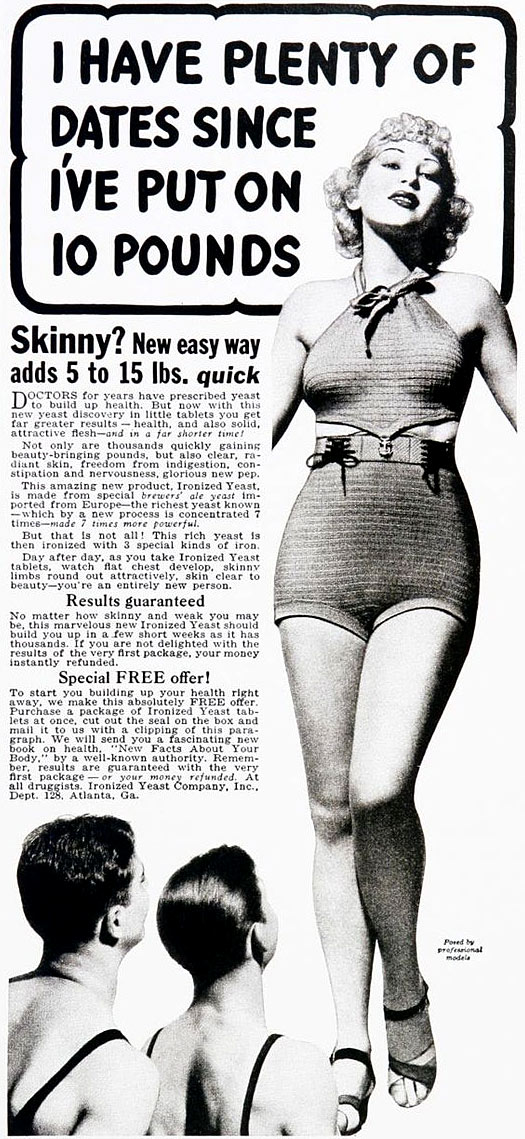 Just yesterday I encountered and read a preprint of a research article that suggests that the environmental crisis of our time may have a dimension few people realize. The article is by Ethan and Sarah Ludwin-Peery, it's published by the Open Science Foundation, and you can download and read it here. The title? "A Contamination Theory of the Obesity Epidemic."
The authors point out that obesity in the developed world follows patterns that make no sense in terms of any of the standard theories. It was relatively uncommon until quite recently -- ads like the one I've posted on the left, which you can find in many old magazines, make it clear that too little weight was as common as too much just three quarters of a century ago. The increase in average body weight doesn't correlate to increasing consumption of sugar, carbohydrates, or any of the other usual suspects, nor do studies support the usual theories about why it's prevalent.
There are also strange details about the distribution of obesity that can't be explained by any of the standard theories. Did you know, for example, that pet animals in the US have been becoming obese at roughly the same rate as human beings? Or that obesity inversely correlates with altitude? Check out a map of the United States showing obesity rates by county -- the paper gives this on p. 5 -- and you can see the mountain and upland regions clearly as regions of relative thinness. Look closely and you'll see that it's not just altitude. Obesity concentrates in river valleys, and the larger the watershed, the higher the obesity rate in the lower reaches of the river.
Fat doesn't flow downhill in continent-sized watersheds, and neither do sugar or carbohydrates -- but industrial pollution does.
That's the possibility that this paper proposes: that some common, persistent industrial pollutant which is present in groundwater has, as a side effect, weight gain in human and animal subjects. The Ludwin-Peerys have done a fine job of investigative epidemiology in their paper, and show that a link between obesity and industrial pollution is the one theory that accounts for the facts. If they're right, the habit of treating the biosphere as a dumpster for chemical wastes may have imposed a cost on society as a whole that nobody's yet taken into account. (Unless -- and whisper this -- the corporations in question have known about this all along, as they knew about the health consequences of tobacco smoking, and kept it secret...)
I expect this paper and the theory it presents to be deep-sixed if the corporate establishment can possibly do so, and denounced in the most shrill tones possible if that effort fails. That being the case, dear reader, you might consider downloading a copy, stashing it somewhere, and taking its ideas into account in your assessments of the future.


Which 'un?
Date: 2021-07-27 07:17 pm (UTC)Re: Which 'un?
Date: 2021-07-27 07:32 pm (UTC)Re: Which 'un?
From:Re: Which 'un?
From: (Anonymous) - Date: 2021-07-27 08:33 pm (UTC) - Expand(no subject)
Date: 2021-07-27 07:48 pm (UTC)I had pitched a research project on estrogen mimics, which of course are now ubiquitous in watersheds, and estrogen is fat soluble so really accumulates in a body. I'd put together a project justification for us to replicate some great research coming out of the US and western Europe to the best of my meagre ability, because the thing about some of these chemicals is that their effects (particularly in amphibians) are inverse to concentration. So, if you have a small amount, ppb, you'll get terrible health effects, frequently reproductive deformities. But ppm or thousandths, and the problems went away (of course, other problems with other chemicals in your contaminating effluent were then so high the problem could not be ignored) . Which meant that paradoxically, the solution to pollution of dilution to the point where concentratiions were below testing thresholds made things much worse. Under the rug.
My mentor was excited, but we had little lab capability to do the work; so he called these former Club guys up. They utterly demolished the idea. Many of their critiques he felt were not so much academic feedback as straight up ad hominem at me, and after some heated exchange, we dropped it. He was fuming about how irrational their reluctance seemed to be, and how unprofessional their treatment of an undergrad had been.
I haven't seen really anything about that research since, but it's not my field, so maybe it just did get debunked. Or.
(no subject)
Date: 2021-07-27 08:28 pm (UTC)(no subject)
Date: 2021-07-27 07:51 pm (UTC)(no subject)
Date: 2021-07-27 08:26 pm (UTC)(no subject)
Date: 2021-07-27 08:22 pm (UTC)I remember listening to a fasting expert talk once and he said that the body stores stuff in fat that it doesn't want to/can't deal with at the time, and that some times when people "can't shed" some bit of weight they might find that the body is resisting it due to the work that will be involved. He was talking about this because I guess during fasts people experience some uncomfortable symptoms (I remember he told a story about a person who was passing out something that smelled like a chemical he'd used in developing photographs decades earlier). It could possibly be related to what you are describing.
(no subject)
Date: 2021-07-27 08:29 pm (UTC)(no subject)
From: (Anonymous) - Date: 2021-07-29 12:00 pm (UTC) - Expand(no subject)
From:(no subject)
From: (Anonymous) - Date: 2021-07-27 10:09 pm (UTC) - Expandfat cell storage
From:It happens
From:(no subject)
Date: 2021-07-27 08:51 pm (UTC)(no subject)
Date: 2021-07-28 08:16 pm (UTC)But!
"Then, in the 1980s, Tennessee attracted two major companies that built enormous plants and established the state as a major force in the automobile and motor vehicle supply industries." https://tennesseeencyclopedia.net/entries/industry/
Thank the gods for cars instead.
(no subject)
Date: 2021-07-27 09:00 pm (UTC)The whole anti-biotic, preservatives, biocides in food is likely part of the problem.
(FYI eating a diet with fermented foods for just a few weeks can greatly increase the diversity of gut microbes. https://www.health.harvard.edu/staying-healthy/fermented-foods-can-add-depth-to-your-diet
https://phys.org/news/2011-01-microbes-gut-genes-obesity-inflammation.html)
If you are up for experimenting on yourself, try adding fermented foods to your diet for a couple of months and take notes on how you are feeling.
(no subject)
Date: 2021-07-28 03:01 am (UTC)(no subject)
From:(no subject)
Date: 2021-07-27 09:18 pm (UTC)The theory also explains in part the stereotype of working-class people as fat, which I have seen with my own eyes is a reality. Not just consumption of foods that put on weight (and provide quick energy for tired bodies), but that there is more pollution in low-income neighborhoods. Which has also been documented and lamented over in the media but not corrected.
Scarlet Obnoxious Sloth
(no subject)
Date: 2021-07-28 03:02 am (UTC)(no subject)
Date: 2021-07-27 09:24 pm (UTC)I've been aware of that phenomenon for years, but the connection I've seen is not between weight gain and industrial pollution as such, but between weight gain and climate change. As the climate warms up, people and animals gain weight, which would produce generally the same pattern you described, including less weight gain at higher altitudes, which are cooler. That's a connection that the powers that be would be less likely to suppress, as it fits with what they consider to be environmental threat number 1. The appeal then becomes "climate change is making you fat, so fight climate change and help reduce your weight!" I've also seen cause and effect reversed, with increased weight being implicated in contributing to climate change because of obese people exhaling more carbon dioxide. Then the exhortation becomes "lose weight to fight climate change!" As much as I support reducing both greenhouse gases and Americans' weight, seeing this makes me think that the relationship between weight and climate can be used to get people both coming and going!
(no subject)
Date: 2021-07-28 03:02 am (UTC)Orthopedic issues in medium-sized and larger dogs
Date: 2021-07-27 09:38 pm (UTC)Re: Orthopedic issues in medium-sized and larger dogs
Date: 2021-07-28 03:03 am (UTC)Re: Orthopedic issues in medium-sized and larger dogs
From: (Anonymous) - Date: 2021-07-29 07:27 am (UTC) - Expand(no subject)
Date: 2021-07-27 09:43 pm (UTC)*See https://pubmed.ncbi.nlm.nih.gov/22387882/ for an example.
(no subject)
Date: 2021-07-28 03:03 am (UTC)(no subject)
Date: 2021-07-27 10:12 pm (UTC)Interesting study. The diets of Americans and the relationship to processed foods also comes into the mix, as the cheaper-to-make/more-profit-to-be-had carb loaded products also started coming on in the 1980s, inline with the faster, on-the-go/no-time-to-cook lifestyles of Americans.
(no subject)
Date: 2021-07-27 11:51 pm (UTC)(no subject)
From: (Anonymous) - Date: 2021-07-28 01:10 am (UTC) - Expand(no subject)
From:(no subject)
Date: 2021-07-27 10:41 pm (UTC)Now I see young women and men like her all the time, some barely able to walk due to their weight. While many can make the case for vegetable oils, lack of exercise and sugar heavy foods, the one thing that has been inexorably increasing has been pollution of every kind. One article I read links the problem to air pollution.
https://airqualitynews.com/2019/11/01/air-pollution-linked-to-obesity-in-young-adults/
I'm sure a search could turn up articles linking other kinds of pollution to this problem. We seem to be facing a perfect storm created by years of industrial garbage which doesn't break down easily and has been accumulating more and more. Now micro-fibers and plastics are joining this witch's brew. I just can't see this ending well.
JLfromNH/Jaundice Senescent Crab
(no subject)
Date: 2021-07-27 11:54 pm (UTC)(no subject)
From:(no subject)
From: (Anonymous) - Date: 2021-07-28 04:30 pm (UTC) - Expand(no subject)
From:(no subject)
From: (Anonymous) - Date: 2021-07-29 07:31 am (UTC) - Expand(no subject)
Date: 2021-07-27 10:50 pm (UTC)The map is the truly intriguing part. I looked up the CDC reference where I couldn't find that specific map but others which also included diabetes in the color coding. Even if there are some flaws in the statistical methods that produced this maps (for a start I'd try shifting the color intervals and see what happens to the map, but there's a whole lot more that one could and probably should do) it will be hard to explain away that things become dramatically worse over time and that there seems to be a rather consistent altitude effect. I'd love to see such maps for other regions of the world...
They put a lot of good work into the paper and I'd have to put a lot more time and effort into understanding and background research to have an educated opinion. I'd dare to say, though, that they are rather careless with their conclusion "obesity is caused by contaminants". It's impossible that contaminants are the SOLE cause for obesity and they provide a lot of evidence for this in their own paper. Going further, I'd say the type of study they are doing is not capable of producing more than correlations. Anyhow, the correlations they observe make a strong case for future studies that could test for a causal relationship. But I think you are right in that this paper will most likely have very little impact. Having been a scientist(tm) myself for several years and having followed the "skeptic vs. believer"-scene for quite some time I see to many red flags. The topic, the conclusions, the authors, the language, some hasty conclusions mixed into all this - no, unfortunately this paper will most likely just be ignored by the mainstream.
For all those, who do not ignore it - the downside of studies like this is that they allow the careless reader to draw tentative conclusions that are only partially justified at best. They're talking about common sense in their paper which I value highly. My common sense and my own observations tell me that chronic fear, chronic anxiety, chronic frustration and chronic boredom are major sources for obesity and other health problems. Probably even more than eating junk food. Mental health issues probably don't correlate to altitude (but, who knows?) but at least these are screws anybody can turn if it need be, even if they have no control on the lithium levels in their tap water (although it should be possible to gather knowledge about the local concentration of at least a few contaminants (lithium should be fairly easy) and develop counter measures, if necessary).
Cheers,
Nachtgurke
(no subject)
Date: 2021-07-28 03:06 am (UTC)(no subject)
From: (Anonymous) - Date: 2021-07-28 12:48 pm (UTC) - Expand(no subject)
From: (Anonymous) - Date: 2021-07-28 04:23 pm (UTC) - Expand(no subject)
From: (Anonymous) - Date: 2021-07-28 10:48 pm (UTC) - Expand(no subject)
Date: 2021-07-27 11:03 pm (UTC)Another caveat: John Ioannidis estimates that a majority of "COVID deaths" (i.e. people who died from various causes after getting a positive PCR test) can ultimately be ascribed to obesity, and most of the rest to smoking.
(no subject)
Date: 2021-07-28 02:50 am (UTC)This doesn't surprise me at all
Date: 2021-07-27 11:18 pm (UTC)God only knows what's in our drinking water because water treatment facilities barely scratch the surface.
Industrial pollution, medications dissolved in our urine that carries over, vitamins, every possible sort of compound.
I remember a 60 minutes (back when they did news) of some guy holding up a fluorescent tube in the air under a mega-powerline and watching it light up! Nobody cared.
None of the powers that be will care about this either.
Teresa from Hershey
(no subject)
Date: 2021-07-27 11:36 pm (UTC)(no subject)
Date: 2021-07-28 03:07 am (UTC)(no subject)
From: (Anonymous) - Date: 2021-07-28 09:14 pm (UTC) - ExpandPollution vs. Lifestyle
Date: 2021-07-28 12:15 am (UTC)I've been especially interested in the lectures of Florida Cardiologist Pradip Jamnadas, founder of The Galen Foundation. He promotes fasting, and thinks we eat not just too much, but too often. https://orlandocvi.com/galen-foundation/
What I'm wondering is how much pollution vs. eating habits influence your weight. Is it useless to even try? I wouldn't want to say "I can't help it I'm fat, there's too much pollution in the environment!" In other words, how do I recognize and address environmental factors which are out of my control, but not turn that into an excuse to avoid making changes in areas that I do control?
Joy Marie
Re: Pollution vs. Lifestyle
Date: 2021-07-28 03:08 am (UTC)Re: Pollution vs. Lifestyle
From: (Anonymous) - Date: 2021-07-28 02:50 pm (UTC) - Expand(no subject)
Date: 2021-07-28 01:08 am (UTC)The most obvious is that the farther up the mountains you go, the more the land slopes. That means that people who live in the hills are likely to do more stair climbing and descending and more walking up and down hills as part of their daily activities than people who live on a plain or in a river valley. Both going up and going down hills and stairs burns more calories than walking an equivalent distance on the flat. It's also aerobic exercise for the lungs and heart. In addition, walking up and down levels is load bearing exercise that builds muscle mass, and muscles have a higher metabolic rate than fatty tissue.
The other physical difference of high altitudes might or might not have any effect that's relevant to obesity. The higher up you go, the lower the concentration of oxygen in the atmosphere. Athletes who want to be competitive at a mile high have to train at a mile high. The reason for that is that if you move from the lowlands to a higher altitude and continue to exercise, your body will respond by producing more red blood cells, making your respiratory system more efficient. I do not know whether this affects digestion.
Interestingly enough, about three months ago I moved from a valley at sea level to about 1500 feet above sea level. My former home was on two stories, and I climbed the stairs about 20 times a day. My daily routine involved walks of 1-3 mostly level miles. Here, I'm going up and down stairs two or three times a day, up a short hill about once a day, and taking very few walks. The water I'm drinking is drawn upstream on a river. Without making any particular effort, I have lost about ten pounds since I moved. If the weight loss continues another couple of months, I won't be obese any more.
(no subject)
Date: 2021-07-28 03:10 am (UTC)(no subject)
Date: 2021-07-28 01:11 am (UTC)(no subject)
Date: 2021-07-28 03:10 am (UTC)(no subject)
From:(no subject)
From:(no subject)
From:(no subject)
From: (Anonymous) - Date: 2021-07-28 04:26 am (UTC) - Expand(no subject)
From: (Anonymous) - Date: 2021-07-28 11:53 pm (UTC) - Expand(no subject)
Date: 2021-07-28 01:27 am (UTC)The human body knows what it needs, and if you don't give it what it needs, it will make you. Since the easiest and most accessible source of dense calories for them is fast food, this makes them into consumers of it, while if they ate a reasonable, healthy diet, they would never consume the stuff. Given this, I find it quite plausible that this is a known effect, and very likely used by big companies to their advantage. I may be too cynical, but I wouldn't be the least bit surprised if whatever it is that causes this is being deliberately released into the environment, with the goal of making people fat, by the same companies selling "cures" for obesity.
(no subject)
Date: 2021-07-28 03:13 am (UTC)(no subject)
Date: 2021-07-28 02:11 am (UTC)(no subject)
Date: 2021-07-28 03:13 am (UTC)(no subject)
Date: 2021-07-28 03:30 am (UTC)Before 1980-ish fat folks were fairly rare.
(no subject)
Date: 2021-08-27 12:01 pm (UTC)(no subject)
Date: 2021-07-28 03:32 am (UTC)(no subject)
Date: 2021-07-28 04:52 am (UTC)Microwave ovens. We did not have these in the home, most people, in the 70's, then by late 70's and on becoming more common. So things like TV dinners used to be in metal and heated in an oven, then later things were heated in plastic in a microwave oven. We did have plastic packaging, like bread bags and plastic wrap on meats and cheeses well before the 80's, but other stuff was not in plastic as much.
(no subject)
Date: 2021-07-28 04:46 pm (UTC)A replication attempt
Date: 2021-07-28 07:25 am (UTC)* Almost all domestic industry has been offshored and much effort has been put into cleaning up pollutants, so air and water quality in the old industrial towns and cities downstream is generally much better than it was pre-1980.
* Almost nobody drinks groundwater, and it's even rarer now than pre-1980, as public water supplies with elevated, natural lakes as reservoirs have been extended to cover most of the country.
There is another geographical correlation, though. Obesity appears to cluster in a number of municipalities along the eastern border of the country, and especially in the far north towards the border with Finland and Russia. Off-hand I can think of a couple of possible explanations for this:
* The north-eastern cluster might very well be affected by industrial pollution coming in from the Russian side
* Genetic differences, as many of these municipalities are traditionally dominated by people of Sami and Finnish ancestry
And true enough, if we look at obesity rates in the native Sami population, they are higher than for the non-Sami. One interesting question to look into is if that might be caused by eating reindeer meat from animals that graze plains that have taken in extreme amounts of industrial pollution over the years.
Re: A replication attempt
Date: 2021-07-28 07:44 pm (UTC)Ah, I found something, here you go: https://www.arcticminerals.se/en/projects/norway/
The mine was closed a several years ago but they plan to re-open. Possibly there are other mines up there in Sweden, Finland or Russia?
Cheers,
Nachtgurke