The Other Picatrix Translation
Mar. 2nd, 2019 04:22 pm![[personal profile]](https://www.dreamwidth.org/img/silk/identity/user.png) ecosophia
ecosophia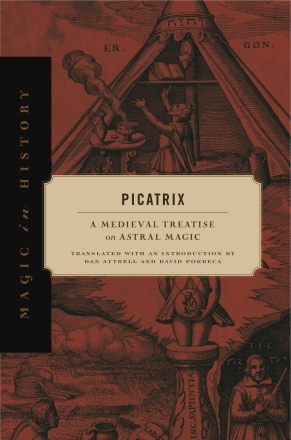 I had the chance a few days back to take a look at Dan Attrell and David Porreca's new translation of the Latin Picatrix, and was pleasantly surprised. Not, mind you, by the fact that it's a capable translation, well introduced and footnoted -- academic standards for such things are pleasantly high these days, and some of the absurd habits that used to pass unchallenged in the history of magic in previous decades have thankfully been put to rest for the time being.
 No, the surprise was that the translators were gracious enough to include the translation of the Picatrix Chris Warnock and I did in their acknowledgments, and also in a footnote, which I can't forbear quoting in full:
"6. Though there already exists a good translation of Pingree's Latin Picatrix, translated and edited by the respectable duo John Michael Greer and Christopher Warnock, their edition appears to be directed toward practicing 'students of medieval and Renaissance magic' or 'students of the occult' rather than toward an audience of historians. See Greer and Warnock, Picatrix, 19." (Attrell and Porreca, Picatrix, 281)
Of course Attrell and Porreca are quite correct. The translation Chris and I did was specifically intended for people who want to practice the magic of the Picatrix; the introduction, notes, and even in some cases the choice of words in our translation were guided by that intention; and it's quite reasonable that historians, whose concerns are very different from those of magical practitioners, would want a translation of their own.
For quite a long time, though, it was de rigueur in the end of the academic community that studies magic to pretend that the modern occult scene doesn't exist, or -- when that scene forced its attention on the academy in some way or another -- to look down their noses at those of us who have kept up the habit of practicing these things. I've sometimes thought of this as being akin to the legendary disdain of the physicist for the engineer, or more generally of those who study theory for those who roll their sleeves up and get into the messy realm of practice. That disdain wasn't helpful for either side, and it's good to see it giving way to something a little closer to mutual respect.
I haven't had the chance to go through Attrell and Porreca's translation in detail yet, but it looks very capable, and I'd encourage anyone whose interest in the Picatrix focuses on history (rather than practice) to pick up a copy. Of course those who are more interested in practice already know where to find a good translation... ;-)


Books written from a skeptical viewpoint
Date: 2019-03-02 10:38 pm (UTC)Even when they get exceedingly annoying (Missing Pieces by Joe Nickell) they can still be useful.
Sympathetic books are, of course, better. For example, Paranormal Experience and Survival of Death by Carl B. Becker.
Re: Books written from a skeptical viewpoint
Date: 2019-03-02 11:10 pm (UTC)Re: Books written from a skeptical viewpoint
Date: 2019-03-03 11:51 am (UTC)Of course, I agree with you that sometimes skeptics can provide useful information in the midst of a debunking.
Renaissance Astrology's Picatrix recommended edition
Date: 2019-03-02 10:45 pm (UTC)Re: Renaissance Astrology's Picatrix recommended edition
Date: 2019-03-02 11:11 pm (UTC)Which one for CGD?
Date: 2019-03-03 12:06 pm (UTC)I'm glad they did have the courtesy of putting your translation in the references!
I was looking at CW's website the other day and wondered about which one of all of them would be compatible for CGD? I'm going to start with your book soon, but I'm really drawn to it because of the divination system and such.
Many Thanks!
Re: Which one for CGD?
Date: 2019-03-03 05:53 pm (UTC)So if the Picatrix interests you, choose whichever one you like, have fun, and take the various warnings in the introduction and text very, very seriously.
Re: Which one for CGD?
Date: 2019-03-03 08:16 pm (UTC)Seems like that should be common sense to me....
Re: Which one for CGD?
Date: 2019-03-03 11:41 pm (UTC)There are things in the Picatrix that can kill you stone cold dead. There are other things that can mess you over in slightly more subtle but even more unpleasant ways. This is serious magic, and it should be handled with the sort of care you use with high-voltage electricity.
Re: Which one for CGD?
Date: 2019-03-04 12:00 am (UTC)Picatrix
Date: 2019-03-03 06:12 pm (UTC)(no subject)
Date: 2019-03-03 07:43 pm (UTC)The original Picatrix was written in Arabic perhaps as much as 200 years earlier. Its usual title is Ghãyat al-Ḥakīm in Arabic. It is somewhat longer than the Latin translation, which was slightly reworked (censored?) by its Spanish translators.
The Arabic text, too, was edited and published by the Warburg Institute in 1933, the work of Hellmut Ritter and Martin Plessner. The same two scholars also translated this Arabic text into German, which, too, was published by the Warburg Institute in 1962.
All three of these Warburg Institute publications can be downloaded for free from the Institute's website as PDFs. (The copyrights are held by the Institute, so these are legitimate downloads.) The links to these downloads can be most conveniently found at the end of the Wikipedia article "Picatrix," but also on the website of the Institute itself.
A new English translation of the Arabic original text is being prepared by Liana Saif. It should appear fairly soon (as academics measure these things).
(no subject)
Date: 2019-03-03 11:46 pm (UTC)(no subject)
Date: 2019-03-04 12:38 am (UTC)Pingree understood that, and that was one of the reasons why he edited the Latin text from all known manuscripts, though he could also read Arabic.
Pingree was not just a world-class scholar, but an amazing polyglot. His colleagues joked among themselves that he had already learned and forgotten more dead languages than most of us could ever manage to learn. But he hadn't actually forgotten any of them, truth to tell: Greek, Latin, Sanskrit, Pali, Arabic, Syriac, Avestan, Pahlavi, and so forth ... His working academic library filled three very large rooms in his office building, with shelves up to the ceilings, and he had read almost everything on those shelves. Not bad for a man who had been blind since childhood in one eye, and who could only read with the other eye at a distance of about 6" from his face. He never would say just how seriously he took the practices of actual magicians, but always very gently deflected any conversation that came at all close to that question. He had a wonderful sense of humor, too.
And among his ancestors were about half of the people accused of witchcraft at Salem in 1692, as he happily told me once.
(no subject)
Date: 2019-03-04 04:15 am (UTC)Re: Ummm...
Date: 2019-03-04 04:13 am (UTC)Re: Ummm...
Date: 2019-03-04 04:42 am (UTC)BTW, this has convinced me not to use archive.org. I refuse to use a site that engages in this sort of behavior.
(no subject)
Date: 2019-03-13 05:02 am (UTC)(no subject)
Date: 2019-04-24 02:52 am (UTC)Warning
Date: 2019-04-23 10:16 pm (UTC)Re: Warning
Date: 2019-04-24 02:55 am (UTC)