Getting the Details Right
Jul. 10th, 2021 07:25 pm![[personal profile]](https://www.dreamwidth.org/img/silk/identity/user.png) ecosophia
ecosophia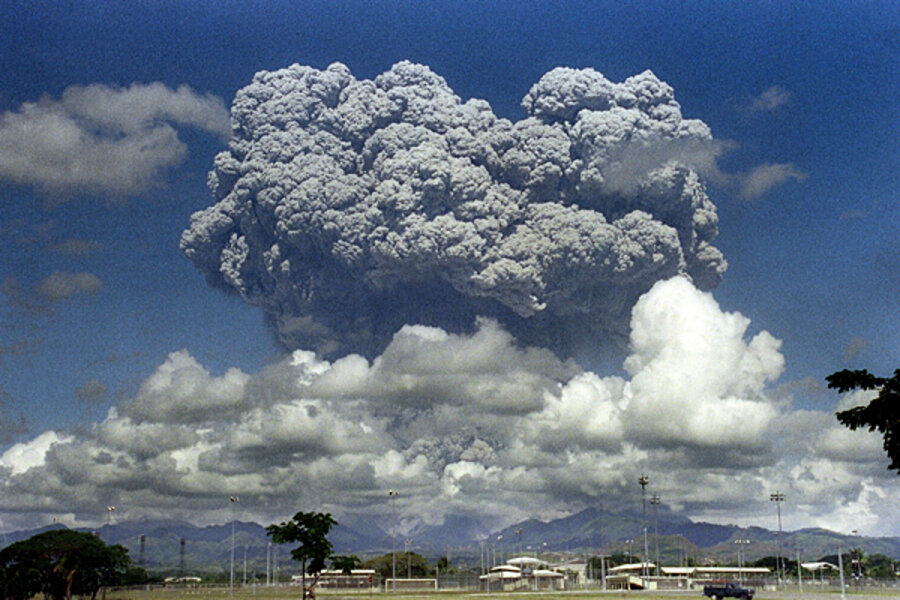 I've been having to ask for more help than usual these days -- many thanks to my readers for pitching in with details! -- and here I am again, with a question for the geologically minded.
 A current fiction project has, as part of the backstory, a major volcanic eruption from an undersea volcano, the Kikai caldera, which is just south of Kyushu Island, the southernmost major island in Japan. It's a big one: an ultra-Plinian eruption of VEI (volcanic explositivy index) 7, with a total of 126 cubic miles of tephra blown into the atmosphere, a column collapse event resulting in a pyroclastic surge that spreads as far as southern Kyushu, then a caldera collapse and resulting tsunami, and of course a high-altitude cloud sufficient to cause a "year without a summer" like 1816, and crop failures across much of the northern hemisphere.
The details I need to know are (a) how big would the tsunami be when it hits nearby land areas, (b) how large would it be when it gets to the far side of the Pacific and slaps the west coast of the US, and (c) how thick of a layer of volcanic ash would land on the Japanese islands. Presumably vulcanologists know these things, but I don't, and I haven't been able to find the appropriate resources online. Any help would be greatly appreciated.


(no subject)
Date: 2021-07-11 12:41 am (UTC)(no subject)
Date: 2021-07-11 02:28 am (UTC)(no subject)
Date: 2021-07-11 12:41 am (UTC)This article form Science Direct just happens to be focused on KiKai caldera. Just in case you haven't stumbled on it yet.
"Tsunami reached up to ~4.5 km from the coast and 50 m above the present sea level at ~40 km south of the caldera"
The data point is from the south from Yakushima island. I would guess that it would be near identical to the north with Makaruzaki being almost directly 40km North on the mainland.
https://www.sciencedirect.com/science/article/abs/pii/S0377027317302937
You seem to be good on the pyroclastic surge details based on the information from this eruption in Akahoya.
https://en.wikipedia.org/wiki/Akahoya_eruption
Please note, I am not a geologist - take this all with a grain of salt.
(no subject)
Date: 2021-07-11 02:28 am (UTC)Krakatoa's Probably A Good First Reference
Date: 2021-07-11 12:52 am (UTC)https://en.wikipedia.org/wiki/1883_eruption_of_Krakatoa
Oh, and don't neglect the sound wave. Krakatoa's explosion was an estimated 310 db, and blew out sailors' eardrums 40 miles away. There were lots of (un)lovely catastrophic effects with this one.
- Cicada Grove
Re: Krakatoa's Probably A Good First Reference
Date: 2021-07-11 02:29 am (UTC)(no subject)
Date: 2021-07-11 12:57 am (UTC)I don't know any good English sources, but I have a few in Japanese, Chinese, or Korean if you can read any of those: plus with any luck having the term and approximate date will help with your research.
(no subject)
Date: 2021-07-11 02:33 am (UTC)I'm sorry to say the only languages I read well are English, French, and Latin, but thanks for the heads up.
(no subject)
Date: 2021-07-11 01:05 am (UTC)Tsunami wave heights are very dependent on the geology of structure along the shoreline, where natural funnels create the highest waves. So my first guess would be the wave heights could be a couple of hundred feet high on nearby islands (Krakatoa's were measured up to 120 feet high). By the time the waves reach North America, they still might be in the triple digits in certain harbors, though the Cascadia earthquake of 1700, which produced damage in Japan, was noted for no earthquake and minor damage.
The ash fallout would be dependent on winds at the time of the eruption - and since this area lies in the transition between westerly and trade wind flows (horse latitudes), it's a real crap shoot. But allows for artistic license....
I poked around looking for a modeling of a similar event or one to plug numbers into, but came up empty. But there are several Youtube videos out there that show some impressive videos.
(no subject)
Date: 2021-07-11 02:34 am (UTC)(no subject)
Date: 2021-07-11 11:58 am (UTC)A year or two of much cooler temps would be expected, though for some reason I thought what if the gods conspired to have a typhoon hit Kikai during the eruption? That would tamp down the ash fallout I imagine...
(no subject)
Date: 2021-07-11 05:32 pm (UTC)(no subject)
Date: 2021-07-11 02:28 am (UTC)Also, I mentioned today is NATIONAL KITTEN DAY on my blog but forgot to do so on either of yours. 😊😳🐡🦙🐈
(no subject)
Date: 2021-07-11 02:37 am (UTC)(no subject)
Date: 2021-07-11 05:33 am (UTC)(no subject)
Date: 2021-07-11 04:34 pm (UTC)(no subject)
Date: 2021-07-11 05:32 pm (UTC)(no subject)
Date: 2021-07-11 05:34 pm (UTC)(no subject)
Date: 2021-07-11 10:36 pm (UTC)(no subject)
Date: 2021-07-12 03:55 am (UTC)(no subject)
Date: 2021-07-12 06:15 am (UTC)(no subject)
Date: 2021-07-20 12:27 am (UTC)~ signed, longtime lurker
(no subject)
Date: 2021-07-11 03:14 am (UTC)A)One possibility is the size of tsunamis predicted if the Cascadia Subduction Zone
ever kicks off again. Granted this is an earthquake rather than a volcanic explosion
but it gives an idea of what might happen.
https://www.oregon.gov/oem/hazardsprep/Pages/Cascadia-Subduction-Zone.aspx
Also historically Krakatoa generated a tsunami of 30 meters washing away over a
hundred villages
https://www.geonet.org.nz/tsunami/story/18830828#:~:text=The%2027%20August%201883%20explosion,villages%20on%20Java%20and%20Sumatra.
B) As for volcano generated waves making it across the ocean enough to be destructive, there
doesnt seem to be much info perhaps because an ocean wide tsunami usually results when an
earthquake (for example) causes a large crustal movement. The energy transfers to the water
and propagates in all directions until the energy peters out. Not sure if a volcano would do
this unless it triggered a massive undersea landslide which might have the same effect.(Think
of what happened to Doggerland thousands of years ago).
C)As for what unfortunate neighbors might experience as far as ashfall is concerned, the
link below shows ashfall estimates from Mount Tambora.
https://nautil.us/issue/31/stress/the-volcano-that-shrouded-the-earth-and-gave-birth-to-a-monster
Experts will tell you what happens depends on so many variables that it's likely to leave you plucking
your beard in anguish, so all you can really do is read up on the subject as much as possible then just
write the story. If it's a good rousing tale, nitpickers can be safely ignored.
JLfromNH/Emerald Gibbering Gopher
(no subject)
Date: 2021-07-11 05:34 pm (UTC)(no subject)
Date: 2021-07-11 06:49 pm (UTC)https://www.bbc.com/future/article/20210702-how-an-earthquake-created-a-village-full-of-sinkholes
Also I don't know if you have ever read The Day The World Ended:The Mount Pelee Disaster by Gordon Thomas and Max Morgan-Witts. Two elements stand out for me (aside from the centipede invasion) was the huge skyscraper like lave spine which formed in the crater after the explosion and an earlier steam eruption which produced an extraordinary whistle which many described as sounding like all the steam whistles in the world going off.
JLfromNH/Emerald Gibbering Gopher
(no subject)
Date: 2021-07-12 04:02 am (UTC)(no subject)
Date: 2021-07-11 02:08 pm (UTC)(no subject)
Date: 2021-07-11 05:37 pm (UTC)(no subject)
Date: 2021-07-11 07:59 pm (UTC)Can't be of any help with this question, though. Should it ever come to physics, it might be different.
Cheers,
Nachtgurke
(no subject)
Date: 2021-07-12 04:02 am (UTC)University of Washington
Date: 2021-07-11 09:09 pm (UTC)Re: University of Washington
Date: 2021-07-12 04:03 am (UTC)(no subject)
Date: 2021-07-11 09:44 pm (UTC)https://www.dnr.wa.gov/geology
Perhaps you could contact someone who runs the simulator (at the WA DNR, or perhaps a major West Coast university geology department) with your location and scenario. I'm sorry I can't suggest something online or at least more targeted and specific.
(no subject)
Date: 2021-07-12 04:04 am (UTC)(no subject)
Date: 2021-07-15 05:36 am (UTC)https://nctr.pmel.noaa.gov/
(no subject)
Date: 2021-07-12 04:09 am (UTC)Volcanic eruption
Date: 2021-07-12 12:22 am (UTC)Raymond R
Re: Volcanic eruption
Date: 2021-07-12 04:05 am (UTC)Re: Volcanic eruption
Date: 2021-07-12 02:01 pm (UTC)There's quite a fun USGS paper on it here: https://pubs.er.usgs.gov/publication/pp1707 it seems to be described as "minor flooding" in Japan.
Re: Volcanic eruption
Date: 2021-07-12 02:15 pm (UTC)For instance, an article at https://eos.org/articles/huge-global-tsunami-followed-dinosaur-killing-asteroid-impact describes a model (shown in the second embedded video; I recommend slowing it down to the minimum playback speed) that suggests wave heights in the tens of meters, on the far shores of the oceans that existed at the time, following the Chicxulub impact. Those waves are estimated at a mile high on the closer shores of the Gulf of Mexico, so the proportion is about right. But of course that's a much larger event.
If your model examples are predicting e.g. 80m high runups at 50km from the caldera, you're looking at waves of less than a meter on the Pacific Coast of North America. You could justify bumping that up by a factor of 2 (5, if you want to push it) due to the Kagoshima peninsula and Tanegashima Island having a "focusing" effect analogous to a gun barrel. They're too close to the source to focus energy on the distant shore very effectively, though.
A half-meter wave would be quite noticeable and a one-meter one would do some shore damage. Locally, bays with focusing effects of their own would be more affected. But perhaps the most dramatic thing about the wave coming to North America might be the information it would provide about what had happened in the East China Sea. Not much information would be coming from anywhere near the source, although presumably satellites would see the plume.
Re: Volcanic eruption
Date: 2021-07-20 03:38 am (UTC)Re: Volcanic eruption
Date: 2021-07-20 01:47 pm (UTC)The linear drop-off of energy with distance is a robust physical effect, provided the initial impulse is omnidirectional and there's open expanse for the wave to expand into. There's plenty of space in the Pacific, but even there, once the wave front reaches the width of the body of water, it would diminish much less if at all as it continued to propagate in the open direction. This map of the estimated tsunami energy from the Tohoku (Fukushima) quake shows a number of those complicating effects in action: there's some directionality to the initial impulse; the drop-off with distance slows down once the spread is limited in the north by the Aleutians and the North American coastline; and the heights amplify along the coastlines. Measured heights reached 2.4 meters in parts of the Oregon and California coasts, and 2m in Chile. (The scale of the map maxes out at 1.2m, so you can't use it to compare wave heights at the coasts.) The highest waves at the coast of Japan have been estimated at near 40m. That's a smaller ratio than the simple inverse-distance model would suggest, and some of the reasons for it, which you can manipulate accordingly in your own scenario.
Re: Volcanic eruption
Date: 2021-07-12 02:19 pm (UTC)https://en.wikipedia.org/wiki/2011_T%C5%8Dhoku_earthquake_and_tsunami
The section 'Elsewhere across the Pacific' describes the impact on the US west coast. Not hundred
foot waves by any means but big enough to cause property damage and sweep away several people who
had wanted to see the wave come in and miscalculated how far they needed to stay away from the shoreline.
JLfromNH/Fulvous Senescent Frog
Tsunami
Date: 2021-07-12 01:30 pm (UTC)https://www.usgs.gov/centers/pcmsc/science/native-american-legends-tsunamis-pacific-northwest?qt-science_center_objects=0#qt-science_center_objects
https://www.usgs.gov/centers/pcmsc/science/local-tsunamis-pacific-northwest?qt-science_center_objects=0#qt-science_center_objects
Re: Tsunami
Date: 2021-07-20 03:43 am (UTC)(no subject)
Date: 2021-07-12 08:27 pm (UTC)(no subject)
Date: 2021-07-20 03:44 am (UTC)Taupo Volcano
Date: 2021-07-12 10:53 pm (UTC)For the ash question you might reference the Taupo Volcano's (https://en.wikipedia.org/wiki/Taupo_Volcano) Oruanui eruption which was VEI 8 but ejected not a lot less than you are stating and covered the most of the central North Island of New Zealand in 200m of material.
Re: Taupo Volcano
Date: 2021-07-20 03:44 am (UTC)