Etheric Technology 1: Mesmer's Baquet
Mar. 2nd, 2021 04:50 pm![[personal profile]](https://www.dreamwidth.org/img/silk/identity/user.png) ecosophia
ecosophia A post I made here a little while back on the subject of radionics got quite a bit of interest, so it occurred to me that a few other historical tidbits on etheric technologies might be worth sharing here. The device to the left is a classic etheric device, and it's also a good beginning place for our story. It's the only surviving example of Franz Anton Mesmer's baquet -- his device for storing and transmitting animal magnetism.
 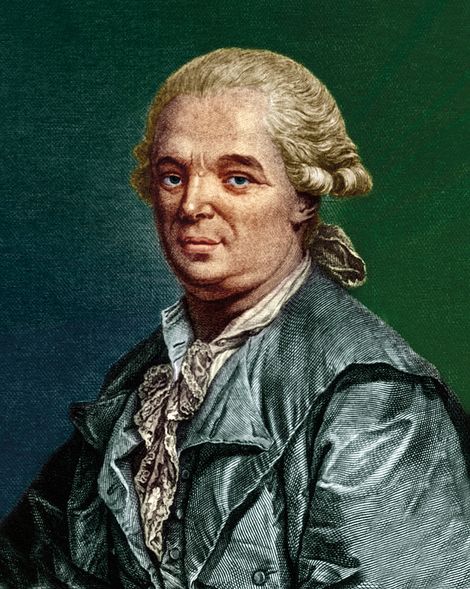 Mesmer was a medical doctor from Austria -- that's him on the right. Like a lot of physicians with scientific interests in his day, he experimented with the medical applications of magnetism, but his experiments convinced him that there was a different force -- like magnetism in some ways, like electricity in others -- that was generated by living things. It obeyed straightforward physical laws, comparable to those that govern the behavior of electricity and light; it could be stored, directed, and made to flow along conductive materials -- and it could heal. He called it "animal magnetism." His experiments in Vienna were successful enough to win him a very substantial clientele and make him enough money that he could hire a talented kid named Wolfgang Amadeus Mozart to write a one-act operetta for a garden party. (Bastian und Bastienne, the operetta, was Mozart's first operatic work, written when he was twelve.)
 The baquet shown above is a very straightforward device, and the diagram to the left shows how it worked. The heart of it was a large Leyden jar. Leyden jar? That's called a capacitor nowadays; it's a glass jar with a layer of foil inside and outside, which was used in electrical research in Mesmer's time as a way to store electric charges. In the baquet, the Leyden jar was surrounded by a thick layer of insulation -- Mesmer used straw -- with bottles of water interspersed with the insulation. At intervals, metal rods descended through the insulation well away from the outside of the Leyden jar, and to the top of each of the rods was fixed a jointed rod that patients held when they were being treated. The baquet was charged by Mesmer himself -- I have not been able to track down the exact method, but it probably involved breathing and concentration, while Mesmer put one hand on the central "double bell" and the other on the ring of metal to which the rods were connected. The baquet may also have gathered animal magnetism on its own account -- as we'll see when we get to Wilhelm Reich, there were fascinating parallels between his technology and Mesmer's.
 It would be quite easy to build a small baquet these days -- there are commercial capacitors with the level of capacitance found in a large Leyden jar, and you can also make the latter with a canning jar, aluminum foil, and rubber cement, and you can also make a sufficiently robust capacitor using sheets of metal and insulation. That I know of, nobody in the current renaissance of etheric technologies has yet done so, but here's hoping.


Capacitances
Date: 2021-03-02 11:52 pm (UTC)The electrical energy stored in a capacitor is the voltage, squared, times half of the capacitance. Charged to 1 kV, a 1nF capacitor would get your attention if discharged through your fingers.
A Leyden jar, with about 1/10th inch of glass jar wall separating the inner metal cylinder from the outer cylinder, could be charged to thousands of volts (perhaps from a Wimshurst machine, or van deGraff generator), without risk of breakdown discharge. Low-voltage capacitors can be made with alternating layers of aluminum foil and waxed paper. Whether such capacitors could withstand animal magnetism experiments or not remains to be seen.
Lathechuck
Re: Capacitances
Date: 2021-03-03 02:39 am (UTC)Testing
Date: 2021-03-03 03:09 am (UTC)And thanks a bunch for this series, I'm very interested in the etheric generally, and in Western approaches especially.
Re: Testing
Date: 2021-03-03 04:34 am (UTC)(no subject)
Date: 2021-03-03 04:07 am (UTC)Fascinating post! Thank you.
(no subject)
Date: 2021-03-03 04:38 am (UTC)(no subject)
Date: 2021-03-03 02:14 pm (UTC)(no subject)
Date: 2021-03-03 06:24 pm (UTC)(no subject)
Date: 2021-03-03 07:49 pm (UTC)(no subject)
Date: 2021-03-03 09:27 pm (UTC)foils
Date: 2021-03-03 11:15 pm (UTC)Re: foils
Date: 2021-03-04 01:15 am (UTC)Re: foils
Date: 2021-03-04 04:12 pm (UTC)Re: foils
Date: 2021-03-05 09:24 pm (UTC)Re: foils
Date: 2021-03-06 06:38 pm (UTC)(no subject)
Date: 2021-03-03 05:07 am (UTC)I just finished reading the Advanced Sciences Research and Development Corporation Inc. paper that you included in the packet and have concluded that I was born at the wrong time in history and that I can’t possibly have enough years on this life, a good reminder that I need to busy myself.
Whoa, this stuff is the future! What I find most fascinating is that it is relatively simple technology so it seems to be Long Descent proof, it doesn’t depend on a gigantic economic monopoly, nor does it require to make people sick often for it to keep running, in its applications to healing and if we get to grasp more things about the life force and how to use it the possibilities for revitalizing the land seem very promising. Besides the real world possibilities I am thinking this technology would make for a great plot for a short story set on a post industrial future.
(no subject)
Date: 2021-03-04 01:16 am (UTC)(no subject)
Date: 2021-03-04 03:08 am (UTC)(no subject)
Date: 2021-03-04 03:40 am (UTC)'Etheric'?
Date: 2021-03-03 05:59 am (UTC)Re: 'Etheric'?
Date: 2021-03-04 01:18 am (UTC)Re: 'Etheric'?
Date: 2021-03-04 02:12 am (UTC)Re: 'Etheric'?
Date: 2021-03-04 03:39 am (UTC)Re: 'Etheric'?
Date: 2021-03-04 04:00 am (UTC)Books ?
Date: 2021-03-03 07:11 am (UTC)Can you recommend a book/s, or is there a book which discusses the ether/Aether from a historical perspective and the history of those who've tried to harness or work with it ?
Regards,
Steve
Re: Books ?
Date: 2021-03-04 01:19 am (UTC)Operations
Date: 2021-03-03 07:45 am (UTC)It is terrible that the early scientists of the day were already that bigoted!
Do you know of any literature on his methods?
Did he publish anything that still survives to this day?
Regards
Re: Operations
Date: 2021-03-04 01:22 am (UTC)Newbie question
Date: 2021-03-03 08:48 am (UTC)Obviously Mesmer wouldn't want to get all snuggly with his patients, but if the exercises at the end of the Dolmen Arch course have you eventually channeling it with your hands, couldn't he have done that?
Re: Newbie question
Date: 2021-03-04 01:24 am (UTC)Orgone Accumulator
Date: 2021-03-03 03:58 pm (UTC)Thanks for this series as well. I'll definitely be following along.
Let the experimentation begin!
Re: Orgone Accumulator
Date: 2021-03-04 01:24 am (UTC)musings on etheric engineering
Date: 2021-03-03 06:17 pm (UTC)Some sources seem to be suggesting that the Leyden jar was a later addition to the surviving artifact rather than part of Mesmer's design. I think this is unlikely. Some also claim that the baquet was filled with water, which I do think is likely, given the rounded and (usually) tapered shapes seen in all contemporary illustrations of baquets, which strongly suggest water-tight construction that would be unnecessary if the interior were dry. Plus there's the name, of course.
Filling the "tub" with water connects the patients to the Leyden jar (some early Leyden jars were filled with water in lieu of the inner foil layer; while less convienient, this would work for the outside as well). If Mesmer touched a patient while also touching the double bell, that would complete the Leyden jar circuit. Reasonably pure water is an insulator for low voltages but becomes significantly conductive at high voltages, which is why the early water-filled Leyden jars with no foil at all (just water connected by a metal rod on the inside, and the experimenter's hand wrapped around the outside) still worked.
This might seem a moot point given that Mesmer by all accounts did not charge the baquets with high-voltage static electricity. But it seems to be a pretty consistent motif in etheric technology in general that high-voltage design principles apply, even without any evident high voltages being present. This can be seen in the overall scale, the sizes of gaps, and the choices of materials. (Simple example: cold water is significantly less electrically conductive than warm water, but at everyday scales that only makes a practical difference at high voltages. Compare that with the effect of temperature on water's etheric qualities.) Reich's designs exhibit such characteristics too.
Re: musings on etheric engineering
Date: 2021-03-04 01:33 am (UTC)Re: musings on etheric engineering
Date: 2021-03-04 04:08 pm (UTC)(no subject)
Date: 2021-03-03 08:55 pm (UTC)(no subject)
Date: 2021-03-04 01:34 am (UTC)(no subject)
Date: 2021-03-04 12:25 pm (UTC)(no subject)
Date: 2021-03-05 09:51 pm (UTC)(no subject)
Date: 2021-03-06 06:55 pm (UTC)In homeopathy the principle is use the "smallest dose" that has an effect. The patient will respond to the energy with a healing "reaction". Reich devices actually impart etheric energy, which is a different approach to provoking a counter-reaction. I suspect both are useful. People with very low life energy (very sick or near death) don't respond well to homeopathy generally. An orgone infusion before homeo rx might help.
(no subject)
Date: 2021-04-10 05:38 am (UTC)